
Hiking with a high or fallen arch turns a dream trail into a punishment march. Your feet ache by mile two, your knees join the protest by mile four, and the next morning you wonder why you bothered lacing up at all. The fix usually isn’t a new pair of feet, it’s better footwear engineering working with your anatomy, not against it. This lineup covers boots and insoles built around real arch geometry, so you can focus on the view instead of the burning in your soles.
A Quick View Of The Lineup

EASYFEET Active Everyday Orthotics Insoles Set
adidas Men’s Terrex Free Hiking Shoe
Kinergy Hiking Boot Insoles for Men & Women

Merrell Jungle Moc Ice+ Men’s
EASYFEET Running & Sport Insoles for Men & Women

EASYFEET Plantar Fasciitis Insoles for Men & Women
EASYFEET Arch Support Insoles for Men & Women
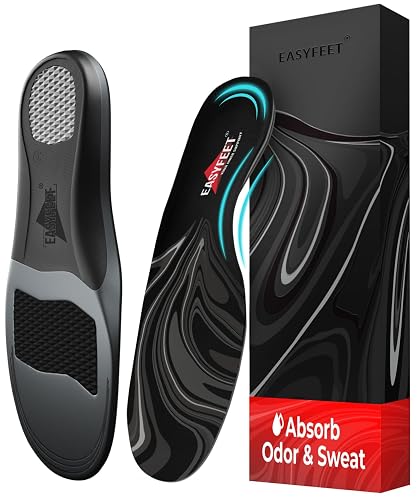
EASYFEET Premium High Arch Support Insoles with Odor Control
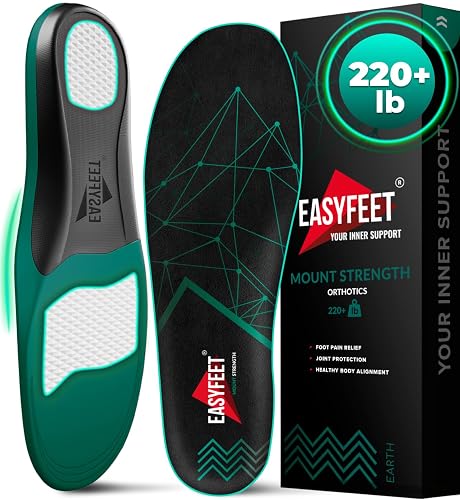
EASYFEET 220+ lbs Heavy Duty Plantar Fasciitis Insoles
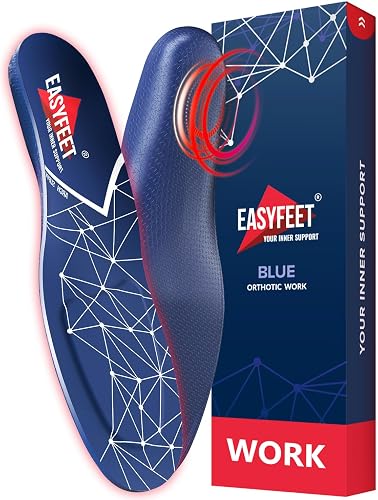
EASYFEET Orthotic Work Insoles for Men & Women
Inside Each Recommended Option
If you rotate between a hiking boot on weekends and a work shoe during the week, a single orthotic rarely fits both lives. The EASYFEET Active Everyday set solves that by shipping two distinct inserts: one tuned for daily wear, another shaped for athletic movement. The arch bridge is contoured to spread pressure across the whole foot instead of letting it pile up at the heel and forefoot, which matters on long approaches where every step compounds.
The cushioning base absorbs the repeated impact that tends to travel up into the shins and knees on rocky terrain. Compared to the heavier-duty picks later in this list, these feel lighter underfoot, a benefit you may notice on fast day hikes. Sizing runs in letter ranges (this set covers Men 9-10.5 / Women 10-11.5), so measure carefully before trimming.
Everyday Perks
- Two inserts let you match the insole to the activity, no swapping mid-day
- Anatomical arch shape spreads load evenly across the midfoot
- Lightweight build keeps boots from feeling clunky on longer miles
- Breathable top fabric helps manage moisture on warm-weather hikes
- Trimmable sizing means a closer custom fit inside snug boots
Things To Consider
- Not engineered for loads above 220 pounds; heavier users may want the reinforced Mount Strength model instead
- Sizing letters assume standard foot width, so wide-footed hikers often trim aggressively
- Top fabric can hold odor after repeated sweaty hikes; air-drying between uses helps
Key Specs
Made For
Hikers who want one orthotic system that works across multiple pairs of shoes without buying a separate insert for each.
Swap It Out When
The EASYFEET Premium High Arch Support Insoles with Odor Control is a stronger daily-driver pick if you need extra cushioning under heavier loads or want improved moisture control on long shifts.
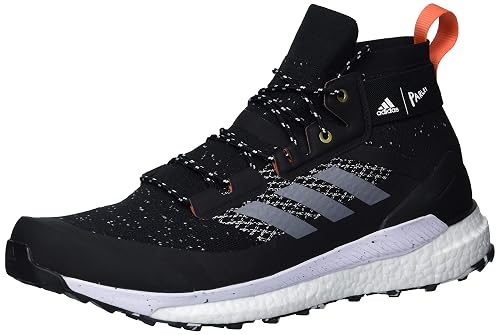
Most hikers with arch issues default to rigid leather boots because they assume more support means more bulk. The adidas Terrex Free flips that script: a hiking-specific shoe engineered closer to a trail runner, with a stable midsole shaped to keep the foot neutral on uneven ground. If your arches ache in traditional boots because the foot has to fight a stiff platform, the lighter construction here can feel like a relief on the very first mile.
Where the Free earns its name is on terrain that demands agility: stream crossings, talus fields, ridge scrambles. Pair it with one of the insole picks in this list if you need extra arch lift beyond what the stock footbed provides. Compared to the Merrell Jungle Moc in slot four, this is a far more athletic, trail-focused option.
Why It Works Well
- Lower profile than a traditional boot, so the foot flexes more naturally on rolling terrain
- Trail-runner DNA makes it nimble on technical ground
- Removable stock footbed leaves room to swap in a custom orthotic
- adidas outdoor fit tends to accommodate a moderate-volume foot
Worth Noting
- Less ankle support than a mid or high-cut boot, so loaded packers may want taller protection
- Minimal insulation means cold-weather hikers should look at the Merrell Jungle Moc Ice+ instead
- Build favors warmer, drier conditions over sloppy mud or snow
Best Suited To
Day hikers and fast-packers who want hiking-boot grip with a lighter, athletic feel and don’t need a tall shaft.
Reach For A Different Pick When
The Merrell Jungle Moc Ice+ Men’s is a stronger match if you hike in cold, wet conditions and prefer a slip-on silhouette over a traditional lace-up.
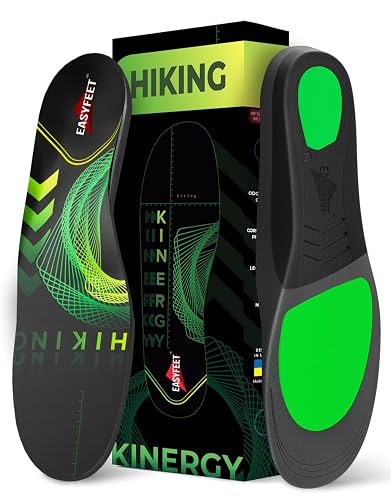
Generic insoles treat every shoe the same, which is why a treadmill insert often disappoints once you hit a rocky descent. The Kinergy Hiking Boot Insoles are tuned specifically for the way boots load the foot: heavy at the heel during downhill steps, pressed forward on climbs, twisted laterally on sidehill traverses. The arch profile is built to stay engaged through all three phases instead of collapsing mid-stride.
Stability is the headline feature here. The base resists the torsion that makes cheaper inserts fold under the ball of the foot, which is a common complaint on multi-day trips. Stack the Kinergy under a boot like the adidas Terrex Free reviewed above and you get a trail setup that handles rough ground without feeling clunky. Sizing runs from XS through larger ranges, so most hikers find a near-stock fit before any trimming.
Real-World Strengths
- Trail-specific geometry keeps the arch engaged on descents and sidehill traverses
- Stiffer base plate reduces foot fatigue on multi-mile days
- Wide size range (XS through larger sizes) covers more foot shapes out of the box
- Works inside hiking boots and sturdier trail shoes alike
Trade Offs
- Higher arch profile may feel intrusive in shallow trail-running shoes
- Stiffer construction takes a few hikes to break in fully
- Not designed as a casual everyday insole; performance tapers off in low-volume shoes
Quick Facts
Whose Trail It Belongs On
Backpackers and day hikers tackling uneven, rocky terrain who need a true boot-grade insert rather than a repurposed running insole.
Consider Something Else When
The EASYFEET Running & Sport Insoles are a smarter pick for hikers who mostly do short, fast-paced trail runs in low-cut shoes and don’t need a stiff boot insert.
Not every arch support story is a backcountry epic. Sometimes it’s the walk to the coffee shop in January on a frozen sidewalk, and that’s where the Merrell Jungle Moc Ice+ slots in. The slip-on silhouette uses a waterproof suede upper, a fleece lining for cold mornings, and a Vibram Arctic Grip outsole designed to bite into slick, icy surfaces. It’s less a hiking boot, more a winter mobility tool, but the arch geometry still matters for daily wear.
The trade-off versus the rest of this list is the construction. This is a casual moc, so it lacks the ankle support and torsional rigidity of a real hiking boot. Treat it as a cold-weather daily shoe with serious ice traction, not as a trail replacement. The fleece interior adds warmth that makes a thin summer sock feel right at home on a snowy commute.
The Upside
- Vibram Arctic Grip outsole delivers real traction on ice and packed snow
- Slip-on design is fast for errands and short winter walks
- Fleece lining keeps feet warm without bulky insulation
- Waterproof suede upper handles slush and shallow puddles
Honest Caveats
- No real ankle support, so it’s not a substitute for a proper hiking boot on uneven terrain
- Casual moc shape offers less arch lift than a dedicated orthotic boot
- Suede requires occasional waterproofing to keep slush from soaking through
The Right Fit
Walkers, dog owners, and casual commuters who deal with icy sidewalks and want grippy winter footwear without lacing up a full boot.
Skip It When
The adidas Men’s Terrex Free Hiking Shoe is a better pick for anyone planning actual trail mileage in mixed conditions where the Jungle Moc’s casual build would feel underbuilt.
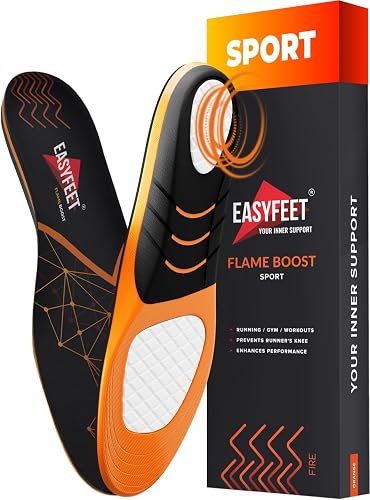
The Flame Boost name hints at the design intent: energy return and impact absorption tuned for high-output movement. Where the EASYFEET Active set in slot one aims for versatile daily support, this pair leans harder into athletic loading. Running, jumping, court sports, and fast hikes all create a sharper heel-strike shock that a generic insole can’t soften, and that’s exactly the gap the Flame Boost aims to close.
The arch profile is firm enough to hold the midfoot through a long run but cushioned enough at the heel and forefoot to avoid the “rock in the shoe” feeling that plagues cheaper orthotics. If you mix trail running with gym sessions in the same week, the same insert can ride in both pairs. Compared to the Kinergy hiking model, this one is lighter and more flexible, a better match for a running shoe than a heavy pack boot.
What It Does Well
- Firmer arch bridge suited to high-impact loading
- Cushioned heel and forefoot zones absorb repetitive shock
- Transitions easily from trail running shoes to cross-trainers
- Targeted shape for activities involving jumping and lateral movement
Points To Keep In Mind
- Not optimized for heavy pack loads; the heavy-duty EASYFEET Mount Strength handles that better
- Higher rebound can feel stiff in casual loafers or low-volume flats
- Expect a brief break-in window as the foam adapts to your stride
Feature Snapshot
Who Will Love This
Runners and gym-goers who log high-impact miles and need the same arch support across multiple pairs of athletic shoes.
Not Your Match When
The EASYFEET Plantar Fasciitis Insoles are a better choice if heel pain is the dominant issue rather than general athletic impact.
Plantar fasciitis pain usually shows up the worst first thing in the morning, then fades as the fascia warms up, which is why an insole’s heel cup matters as much as its arch. The EASYFEET Black uses a deep heel cup to cradle the rearfoot, keeping the natural fat pad centered under the calcaneus (the heel bone) instead of letting it spread sideways. Combine that with a firm arch bridge, and the result is a controlled load through the entire foot.
For high arches, the bridge fills the gap so weight doesn’t sit only on the heel and ball. For flat feet, the same bridge stops the foot from rolling inward, a motion called overpronation. Both cases benefit from pressure spread more evenly across the foot. Pair these with a roomy hiking boot rather than a low-cut fashion sneaker, where the cup can feel cramped.
Positive Points
- Deep heel cup stabilizes the rearfoot and reduces morning stiffness
- Firm arch geometry works for both high arches and flat-footed hikers
- Pressure redistribution eases load on the plantar fascia during long miles
- Heel-focused design addresses the most common source of arch-related pain
Practical Considerations
- Heel cup depth takes up volume; shallow shoes may feel tight
- Not specifically built for high-impact running; better suited to walking and hiking
- Stiffer feel than the EASYFEET Active set, so casual users may prefer that model for daily wear
Right Fit For
Hikers who feel heel pain first thing in the morning or after long descents and want a structured insert that targets the source.
Where Another Pick Suits Better
The EASYFEET Core Energy Arch Support Insoles offer a similar arch bridge with a slightly softer feel for hikers who find this model too firm.
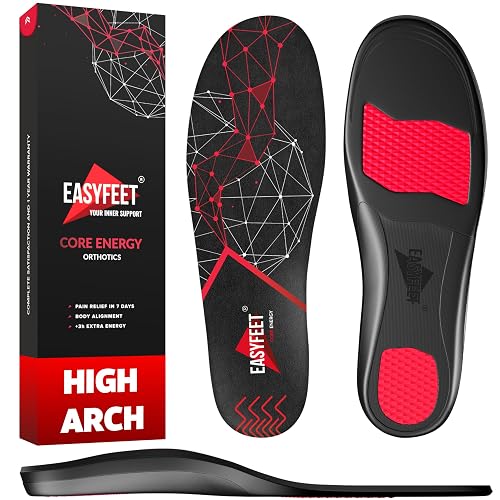
Core Energy is positioned as EASYFEET’s refined, second-generation take on the everyday arch support insole. The design targets the most common foot types: flat feet, fallen arches, and high arches, all with the same geometry. The result is a single insert you can rotate across hiking boots, work shoes, and casual sneakers without buying a different model for each.
The deep heel cup keeps the rearfoot planted, while cushioning at the heel and forefoot absorbs the shock waves that travel upward on hard-packed trails. Compared to the Plantar Fasciitis model in slot six, the Core Energy is slightly less aggressive in the heel cup, which makes it a friendlier fit in shoes with less volume. For most hikers, this is the most versatile single-purchase option in the lineup.
A Few Strong Suits
- Updated geometry addresses the limitations of earlier EASYFEET designs
- Works across flat feet, fallen arches, and high arches without swapping inserts
- Deep heel cup and forefoot cushioning work together for steady support
- Versatile enough to move between boots, sneakers, and casual shoes
A Few Limitations
- Not tuned for very high body weight; the Mount Strength in slot nine is built for that
- Less sport-specific than the Flame Boost, so runners may want that model instead
- Initial feel can be firm for wearers used to soft gel insoles
Who Should Grab It
Hikers who want one do-it-all orthotic that handles flat feet and high arches equally well across a varied shoe rotation.
Look Elsewhere When
The EASYFEET Plantar Fasciitis Insoles are a better fit if heel pain is your primary symptom and you want a deeper, more aggressive heel cup.
The Black Onyx is the dressier sibling in the EASYFEET family. It’s positioned as a premium everyday insert, with material choices that lean toward long office days, conference halls, and city walking rather than trail abuse. The high, firm arch fills the gap under a high-arched foot so weight doesn’t concentrate on the heel and ball, and the layered cushioning absorbs the steady shock of standing or strolling on hard floors.
What sets it apart from the rest of the EASYFEET line is the odor-control treatment. Anyone who has spent a long day in closed dress shoes knows how quickly insoles can become a problem, so this feature earns its place for wearers who don’t get to air out their footwear between uses. The trade-off is that the construction isn’t built for rugged trail conditions, so swap into a Kinergy or Mount Strength for backcountry days.
Practical Pluses
- Layered cushioning targets the steady pressure of long standing or walking days
- High arch fill matches the geometry of a high-arched foot
- Odor-control treatment helps in shoes that don’t get aired out frequently
- Premium material selection makes it a good match for dress and office footwear
Honest Caveats
- Not designed for heavy trail use; the build is more office than outback
- Premium materials cost more than the everyday EASYFEET options
- High arch profile may feel overbuilt for flat-footed wearers
Built With In Mind
Office workers and city walkers with high arches who want a refined everyday insert that handles long hours on hard floors.
A Better Fit Elsewhere
The EASYFEET Orthotic Work Insoles are a smarter pick if your “all day on your feet” job involves more standing than walking, since they’re tuned for anti-fatigue support specifically.
Standard orthotics compress under heavier body weight, and a once-firm arch can bottom out after a few months of daily use. The Mount Strength is built specifically to hold up under loads above 220 pounds, with extra reinforcement through the arch bridge. The shape mirrors the standard EASYFEET design, so the feel is familiar, but the materials are tuned to resist the collapse that frustrates heavier hikers.
This makes the Mount Strength a good match for anyone carrying a heavy pack on long trips, where the combined load of body plus gear can quickly overwhelm a generic insole. The trade-off is added rigidity, which some wearers may feel as stiffness in flexible shoes. Pair it with a sturdy hiking boot like the adidas Terrex Free and the system handles the load without complaint.
Where It Helps
- Reinforced arch bridge resists compression under heavier body weight
- Stronger construction handles pack loads on multi-day trips
- Same familiar EASYFEET shape with upgraded internals
- Spreads weight across the whole foot rather than concentrating at the heel
Potential Compromises
- Heavier and stiffer than the standard EASYFEET inserts
- Overkill for lighter hikers who don’t need the extra reinforcement
- Higher rigidity requires a break-in period and a roomy boot to feel right
Technical Highlights
Perfect Match For
Heavier hikers and backpackers who find standard orthotics flattening out too quickly under their body weight plus pack load.
Wrong Turns To Avoid
The EASYFEET Active Everyday Orthotics Set is a smarter pick if you’re under 200 pounds and don’t need the reinforced build, since you’ll get a lighter, more flexible feel for less.
Standing on concrete for ten hours a day is its own form of endurance sport, and it’s the use case this insert is built for. The EASYFEET Orthotic Work Insole targets fatigue and leg pain that builds up over long shifts, with an anti-fatigue geometry that supports the arch under constant, low-intensity load. The construction is firmer than a casual insert, since the foot needs structure more than rebound in this scenario.
The model lands at the end of the lineup because it’s a specialized pick: best for hikers whose work shoes are where the arch pain actually shows up, not their trail footwear. If you spend weekends on the trail and weekdays on your feet in a kitchen, warehouse, or retail floor, this is the insole that solves the weekday half of the problem. The Black Onyx in slot eight covers a similar audience with more cushioning, so consider which profile matches your day.
Bright Spots
- Anti-fatigue design eases the leg pain that comes with long standing shifts
- Firm arch holds the midfoot up under constant load
- Works well in work boots, shoes, and casual footwear
- Targets the specific pain pattern of standing-all-day jobs
Soft Spots
- Not built for high-impact sports, so the Flame Boost handles that role better
- Firmer feel may bother wearers who prefer cushioned everyday insoles
- Limited use case beyond work; the Active set covers more ground for general wear
At A Glance
Who It Suits Best
Workers in kitchens, warehouses, healthcare, and retail who stand on hard floors all day and want a structured orthotic in their work shoes.
A Better Fit Elsewhere
The EASYFEET Plantar Fasciitis Insoles handle the same long-shift pain with a deeper heel cup if your specific symptom is heel pain rather than general leg fatigue.
What To Weigh Before Choosing Footwear And Insoles For Arch Support
Arch support is not a single dial. It interacts with foot volume, body weight, intended activity, and the shoe the insert rides inside, and getting the combination right is where most people go wrong. The picks above split between actual hiking footwear and replacement insoles, so start by deciding which side of that split matches your real situation. Trail runners and lightweight hikers often just need a better insole in a shoe they already own, while full-pack backpackers may want a true hiking boot paired with a dedicated orthotic.
Foot shape matters as much as arch height. A high-arched foot needs an insert that fills the gap, while a flat foot needs one that prevents the midfoot from rolling inward (overpronation). Weight is the other quiet variable. Standard insoles compress faster under heavier loads, which is why a reinforced model earns its premium for backpackers and anyone above 220 pounds.
Lacing, sock choice, and break-in time all shape the final experience. A new orthotic often feels intrusive for the first few hikes, and that’s normal. Most insoles need a handful of outings before the foam settles into your stride. The source data for every pick in this list provides only the manufacturer’s published specifications, so any fit-and-feel judgments come from comparing those specs against typical use patterns rather than from hands-on trials.
Key Considerations Across These Picks
Where Shoppers Go Wrong
The most common mistake is buying an insole without checking the shoe’s volume first. A deep heel cup in a low-cut sneaker creates pressure points, and a thick arch bridge in a shallow dress shoe can make the foot slide around. Measure the toebox depth and the removable insole thickness before you order, and compare that to the new insert’s profile. Another frequent slip-up is skipping the break-in period: a few short days of wear around the house reveals fit problems before you’re five miles from the trailhead.
Where The Extra Money Goes
Premium-tier insoles justify their cost with denser foams, more sophisticated arch geometry, and specialized treatments like odor control. For everyday casual wear, the upgrade is mostly comfort and longevity. For hiking specifically, the higher tier often means reinforcement that resists compression under pack load, which is a functional gain rather than a luxury. The honest read is that the upgrade pays off most for heavier hikers, multi-day backpackers, and anyone whose feet demand more than a basic foam liner can deliver.