
Cellular trail cameras solve the problem of checking image cards in mud, rain, or darkness. I focus on remote monitoring, trigger speed, nighttime detail, power options, and outdoor resilience, with particular attention to hunters, wildlife watchers, and property owners monitoring remote land.
A 4G LTE connection sends images through a cellular network rather than local WiFi, while trigger speed determines how quickly the camera reacts after detecting movement. Solar accessories can extend remote operation, but placement, exposure, and carrier coverage remain important.
The Main Contenders

Assark Solar Trail Camera 48MP WiFi Bluetooth 0.2s Trigger IP66 32GB

4G LTE Cellular Trail Camera 2.5K Live Feed
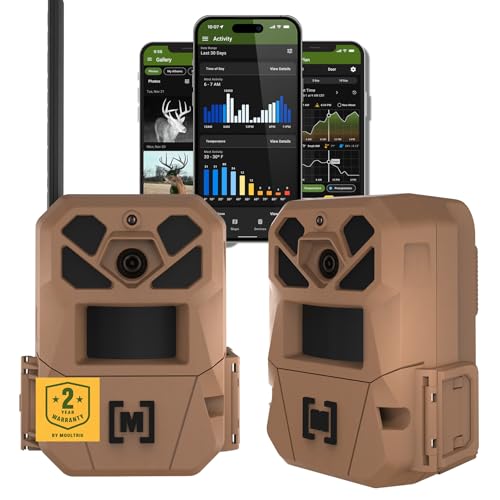
Moultrie Edge 3 Cellular Camera 2-Pack 40MP

Moultrie Edge 3 Cellular Camera 40MP 0.5s Trigger

Moultrie Edge 3 Cellular Camera 40MP 3.4W Solar Pack
SPYPOINT Flex-M Solar Bundle Dual-Sim LTE GPS IP65

SPYPOINT Flex-M Twin Pack 28MP 720p Sound
More On The Choices That Made The List
The Assark model makes more sense for a cabin, hunting property, or woodland near a strong WiFi signal than for land without wireless service. Its local connection avoids cellular subscription requirements, while the 48MP sensor and 30FPS capability can record greater detail and short movement sequences.
Solar construction suits a fixed trail or bait station, and the stated 0.2-second trigger should suit fast-moving subjects in an open monitoring area. Owners still need unobstructed sun and should confirm that the app supports their phone and location before mounting it.
Real Benefits
- The included 32GB microSD card removes the need to purchase removable storage immediately.
- IP66 sealing helps protect the electronics during rain, dust, and seasonal weather changes.
- Built-in solar charging reduces regular battery handling in exposed placements.
- Night vision supports observation after daylight fades.
Honest Caveats
- This is not a cellular camera, so it does not satisfy remote LTE monitoring needs.
- Solar output depends on panel direction, nearby shade, and seasonal sunlight.
Built With In Mind
It fits a hunter or wildlife watcher who can place a standard WiFi-enabled camera at a sheltered woodland site.
A Better Fit Elsewhere
The Moultrie Edge 3 Cellular Camera 40MP 0.5s Trigger better serves monitoring locations beyond reliable WiFi range.
The appeal here is immediate visibility rather than waiting for a later image download. Its 2.5K live feed gives property owners a practical way to inspect a driveway, gate, cabin, or remote access point through an app, provided cellular reception is adequate.
Compared with the Assark, this camera offers genuinely remote cellular use, but its value depends more heavily on signal and service. The included SIM card is convenient, although activation requirements and ongoing transmission costs should be confirmed before installation.
Real-World Strengths
- Live viewing shortens the delay between detected motion and remote inspection.
- 2.5K resolution gives on-screen views more definition than a low-resolution security feed.
- The included SIM card removes one preliminary purchase from activation.
- Cellular operation supports locations without WiFi infrastructure.
Things To Consider
- Cellular signal can deteriorate inside dense woods, valleys, or metal-sided structures.
- Live viewing consumes more power and cellular data than scheduled still-image transmission.
- The solar aspect is unclear for this model, so battery planning deserves attention.
Made For
It suits someone who values a live phone view from a property with dependable 4G coverage.
Another Choice May Suit
The SPYPOINT Flex-M Solar Bundle Dual-Sim LTE GPS IP65 better serves remote users who need bundled solar equipment.
Two cameras solve a common monitoring problem: one trail may show travel past a gate, while another overlooks a feed or crossing. The Moultrie Edge 3 pair provides 40MP stills and a 0.5-second trigger, giving hunters and wildlife observers greater placement flexibility than a single-camera setup.
Its four-network automatic connection can ease carrier selection across major U.S. networks, though wooded locations may still present coverage gaps. I favor this option for covering separate areas rather than stacking two units in one location.
Where It Excels
- The two-camera format allows simultaneous monitoring of separate trails or approaches.
- 40MP stills provide useful detail for identifying distant animals and landscape features.
- The 0.5-second trigger reduces delay around subjects moving briskly through frame.
- Automatic network selection simplifies cellular setup across supported U.S. carriers.
Minor Gripes
- Two installations require separate mounting, maintenance, and battery attention.
- No solar panel is identified for this bundle, making long-term power planning necessary.
Feature Snapshot
Best Suited To
This pair fits hunters and property stewards monitoring two separated hotspots from one cellular platform.
Where A Sibling Pick Shines
The single Moultrie Edge 3 Cellular Camera 40MP 0.5s Trigger is easier to manage for a concentrated trail.
A single Edge 3 is the cleaner choice for one well-chosen crossing, feeder, or access lane. Its 40MP still images support distant wildlife evaluation, while the 0.5-second trigger helps preserve the moment without placing the burden of a second installation on the owner.
Compared with the two-camera Moultrie option, this model concentrates the same core imaging specifications into one unit. For regular scouting, that simplicity can outweigh broader placement coverage, especially in remote terrain.
What Helps Most
- 40MP capture adds clarity to subjects viewed across a clearing or field.
- The 0.5-second reaction time supports fast-moving wildlife.
- Automatic connection across four major U.S. networks simplifies carrier selection.
- One-camera ownership keeps setup and maintenance focused.
Points To Keep In Mind
- Cellular transmission needs compatible coverage at the exact mounting point.
- A field without paired hotspots gains little from the single-camera format.
- Owners must select a power arrangement suited to sun exposure and transmission frequency.
The Right Fit
It fits a hunter or landowner with one primary trail and dependable cellular reception.
Swap It Out When
The Moultrie Edge 3 Cellular Camera 2-Pack 40MP better serves someone tracking two separate locations.
The included 3.4W solar pack makes this Edge 3 setup more practical for continuous field use. A gate, feeder, or cabin monitored through frequent image transmission can benefit from routine solar charging, particularly during seasons with limited opportunities to visit.
Unlike the bare Moultrie model, the panel reduces the daily battery-planning burden without changing the camera’s 40MP image emphasis. Tree cover or frequent animal movement across the panel can still interrupt charging, so orientation matters.
Strengths Worth Knowing
- Solar charging suits fixed cameras that transmit images throughout the day.
- The 40MP sensor preserves useful still-image detail for wildlife identification.
- A 0.5-second trigger catches movement with less delay.
- Four-network selection improves carrier setup across supported U.S. areas.
- Solar and camera arrive together, reducing accessory matching.
Practical Considerations
- Shade and debris on the panel can lower charging performance.
- Transmission frequency and cellular signal still influence battery demand.
Key Product Details
Who Will Love This
It fits an experienced field user who wants cellular alerts and solar charging at one fixed site.
Reach For A Different Pick When
The SPYPOINT Flex-M Solar Bundle Dual-Sim LTE GPS IP65 better fits setups that also need GPS and a supplied mounting system.
The Flex-M bundle is built around a complete off-grid installation. It combines the cellular camera, a compact SPLB-10 solar panel, an installation strap, and a heavy-duty mounting arm, reducing the need to assemble those pieces separately.
Dual-SIM LTE can make carrier selection less restrictive, while GPS assists with location awareness. IP65 water resistance offers outdoor protection, although the camera still benefits from stable mounting and a clear view of the panel.
Points In Its Favor
- The complete package supports faster remote installation with fewer separate purchases.
- Dual-SIM capability offers a practical way to manage compatible cellular connections.
- Solar charging suits a hunting property or access point without nearby power.
- GPS and night vision broaden monitoring beyond daylight encounters.
Small Caveats
- The solar panel needs direct exposure and occasional cleaning.
- Trees, terrain, and distant tower placement can still interrupt cellular service.
Feature Card
Who Should Grab It
It suits a first-time remote installer who wants solar power, mounting parts, and cellular service together.
Not Your Match When
The Moultrie Edge 3 Cellular Camera 40MP 0.5s Trigger better fits someone who prioritizes 40MP stills over bundled mounting gear.
Two Flex-M cameras cover a front gate and woodland trail, two ends of a property, or separate approaches to a hunting area. Each records 28MP photos and 720p video with sound, making the pair useful where environmental context matters alongside visible movement.
Compared with the Moultrie two-pack, these cameras emphasize recorded audio and include dual-SIM LTE, GPS, night vision, and IP65 water resistance. Solar charging is not identified here, so batteries still deserve planning.
The Case For It
- Two units provide simultaneous coverage of distinct property areas.
- Recorded sound can add context to wildlife calls, voices, and machinery.
- Night vision supports movement detection after dark.
- Dual-SIM LTE accommodates compatible cellular network choices.
- On-camera controls help with basic formatting and setup away from a vehicle.
Possible Compromises
- 720p video has less detail than the 40MP still-oriented Moultrie options.
- Two cameras double the mounting and battery maintenance.
- Cellular reception remains dependent on terrain and tower location.
The Right Fit
It fits a hunter or property owner who wants two camera positions plus audio-enabled video.
Consider Something Else When
The Moultrie Edge 3 Cellular Camera 2-Pack 40MP better serves users who prioritize higher-resolution still images.
What Matters Before Choosing A Cellular Trail Camera
Coverage deserves the first check. A 4G LTE camera needs usable signal at the mounting point, not merely in the nearest town, and two-network support may provide useful flexibility. I would also compare the camera with the phone app and cellular activation process before mounting anything.
Trigger speed, defined as the delay between detected movement and image capture, matters for active animals and people crossing the frame. Still-image resolution, night vision, recording format, and the ability to capture sound should match the intended activity rather than the largest number printed on the box.
Power arrangements shape long-term ownership. Solar panels can reduce battery changes, yet shade, panel orientation, and transmission frequency affect charging needs. A two-camera setup also requires twice the attention during weather inspections, lens cleaning, and battery checks.
Two Details That Affect Remote Monitoring
Pitfalls Shoppers Hit
A common mistake is choosing by resolution while overlooking signal strength. Another is placing a solar panel under branches or behind the mounting strap. Confirm cellular reception, app compatibility, power exposure, and insertion direction at the intended site.
What Separates Premium From Basic
Additional money may support denser stills, faster triggers, wider carrier compatibility, live viewing, or bundled solar equipment. Those gains matter most at remote sites where difficult access makes battery service, clearer identification, and reliable transmission particularly valuable.