
A handheld metal detector solves a specific problem: locating small metallic objects without sorting through an entire area blindly. I focus on options for shoreline searches, reclaimed lumber, security screening, and precise recovery work, while separating true pinpointing tools from scanning wands and digging accessories.
The Choices Worth Comparing

NOKTA MAKRO Waterproof Pointer 10000110

Garrett Pro-Pointer AT 20ft with Dig Pouch
CKG Metal Detector Shovel, Double Serrated Edge, Sheath Knife, Black

JKUSS Rechargeable High-Sensitivity Metal Detector Wand

Garrett Super Scanner V Handheld Wand
JKUSS 5-Level Handheld Metal Detector Wand

JKUSS Rechargeable 5-Level Metal Detector Wand with Holster
Meet The Standout Selections
The NOKTA MAKRO serves a different purpose from the security wands later in this roundup. Its narrow pointer format is intended to confirm a small target after a wider detector has narrowed the search area, making it especially useful around roots, stones, and shoreline debris.
I like its land-and-water versatility for compact searches, particularly where carrying a full-size detector would be awkward. The sealed body carries an IP67 water-resistance rating, which protects against immersion under defined conditions, though it isn’t the same as specifying a maximum operating depth.
What Earns Its Place
- The 9.4-inch body fits comfortably inside a pocket or belt pouch.
- Audio and vibration alerts support both shoreline listening and quieter recovery work.
- Four sensitivity levels help separate large debris from smaller buried objects.
- Water resistance allows one compact tool to cover land and underwater locations.
A Few Limitations
- A pinpointer is intended for precise recovery, not scanning an entire field.
- Rinsing with fresh water and drying the seams after beach use is sensible ownership practice.
Key Attributes
Built With In Mind
This pointer suits beginners and traveling hobbyists who need a small confirmation tool for beaches, shallow water, and landscaped areas.
Another Choice May Suit
Beach hobbyists who submerge the tool deeply may prefer the Garrett Pro-Pointer AT 20ft with Dig Pouch.
Compared with the NOKTA MAKRO, the Garrett Pro-Pointer AT makes a stronger case for serious shoreline and freshwater work. Its stated 20-foot waterproof rating gives swimmers and boat-based hobbyists more freedom around the waterline instead of limiting use to surface recovery.
For searching mineral-rich sand, fast retuning is the detail I would prioritize. Retuning means quickly adapting the detection field as conditions change, while the three sensitivity levels provide control for targets ranging from small gold nuggets to ordinary shoreline debris.
Everyday Perks
- Full waterproofing supports recovery in rivers, lakes, and surf zones.
- Fast retuning reduces disruption in mineralized beach sand.
- Three sensitivity levels suit varying target sizes.
- The included dig pouch keeps the pinpointer and recovery tools together.
- A lost-pinpoint alarm helps prevent a tool from being left behind.
Worth Bearing In Mind
- It remains a recovery tool rather than a wide-area scanner.
- Mineralized sand may still require patience despite the retuning controls.
- Freshwater rinsing and complete drying are sensible after each submerged outing.
Technical Sheet
The Right Fit
Frequent beach swimmers, freshwater hobbyists, and recovery-focused metal detecting users gain the most from its submerged capability.
A Better Fit Elsewhere
Gardeners seeking a recovery tool for damp soil may find the NOKTA MAKRO Waterproof Pointer 10000110 lighter and less specialized.
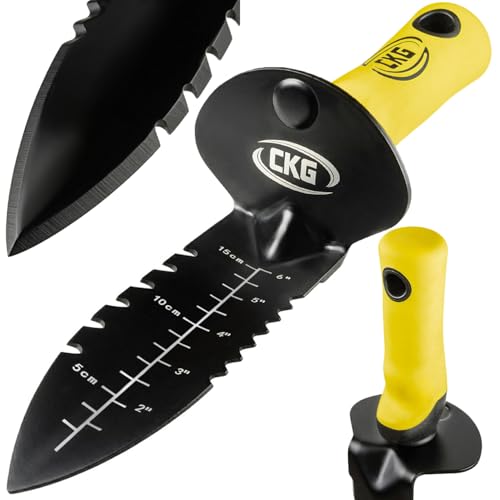
The CKG shovel is not an electronic detector, so its place here depends on ownership rather than scanning. It handles the work that follows a successful signal: cutting into compact soil, loosening a buried object, and filling the hole without bringing a large spade.
Its reinforced handle-to-shovel connection and double-serrated edge look purposeful for repeated recovery work. For a hobbyist moving between yard projects and old foundations, that crossover use may matter more than minimizing weight.
The Good Stuff
- Double serrations bite into compact soil and resist slipping during controlled digging.
- The reinforced connection supports repeated use around stones, roots, and packed ground.
- Its narrow form is easier to control than a full-size garden spade.
- The included sheath knife broadens the set for campsite and recovery tasks.
Practical Considerations
- It will be heavier than a lightweight garden trowel during long sessions.
- Dry soil and established roots can place more stress on any digging tool.
- The connection and serrations need occasional cleaning to avoid trapped soil and abrasion.
Made For
Metal detecting hobbyists and gardeners benefit most from its compact, reinforced digging design.
Where A Sibling Pick Shines
Recovering a target directly underwater is the Garrett Pro-Pointer AT 20ft with Dig Pouch’s stronger use case.
The JKUSS wand shifts the roundup from buried treasure recovery to rapid inspection. Its scanning form is suited to people checking reclaimed boards, packages, event areas, or work zones for nails, screws, jewelry, and other concealed metal.
A rechargeable body removes the need to keep spare cells on hand, while sound, vibration, and LED choices make the wand practical in louder or darker settings. Depending on the site, that flexibility may matter more than the very low operating weight of a handheld pinpointer.
The Value In It
- Rechargeable operation supports repeated shifts without disposable battery changes.
- Three alert modes suit noisy events, close inspection, and low-light work.
- A broad scanning shape covers clothing and lumber faster than a pinpoint probe.
- It serves security, woodworking, and event-screening tasks in one portable form.
- Small-object detection can help prevent hidden nails from reaching cutting tools.
Smaller Details To Watch
- It is intended for close-range scanning rather than locating deeply buried targets.
- Charging access and battery condition should be checked before a busy shift.
- A wipe-down after use helps prevent dirt from accumulating around the casing.
Feature Snapshot
Who Will Love This
Event teams, workshop users, and casual security staff benefit from a rechargeable close-range inspection wand.
Look Elsewhere When
Underwater recovery calls for the Garrett Pro-Pointer AT 20ft with Dig Pouch rather than this scanning wand.
The Garrett Super Scanner V is the most direct security-screening option here, with published detection distances for several target classes. Those figures give a more concrete sense of expected reach than a generic sensitivity claim, especially for staff checking clothing at events or controlled entrances.
Unlike the JKUSS wand, its listed performance emphasizes response to medium and large metal objects at short distances. For routine screenings, that defined range is easier to plan around, though it doesn’t make the tool suitable for field treasure hunting.
What Pays Off
- Published target distances simplify expectations for routine inspections.
- The listed reach supports checks around clothing, bags, and entry points.
- A handheld format gives security staff a practical scanning motion.
- It is identified as made in the USA, which may matter to some organizations.
Potential Compromises
- It is not designed for water, soil, or deep field detection.
- Short detection distances make close inspection passes important.
- Regular surface cleaning helps preserve reliable contact and prevents dirt buildup.
Quick Facts
Right Fit For
Professional event and access-control staff benefit from its clearly stated short-range detection classes.
Another Choice May Suit
Woodworkers needing selectable depth levels may prefer the JKUSS 5-Level Handheld Metal Detector Wand.
Five sensitivity levels give the JKUSS wand more adjustment than the other security scanners in this group. That makes it especially relevant to reclaimed timber, where staples may sit near the surface while a nail lies deeper inside an old board.
The choice of audible beep, vibration, and LED alerts also suits different workspaces. In a loud shop, vibration may be easier to notice, while a lamp can help during dim storage areas; the honest caveat is that the settings still need to be matched to the material being inspected.
A Few Highlights
- Five levels offer finer adaptation than a fixed or minimally adjustable wand.
- Multiple alert styles support noisy shops, quiet rooms, and dim workspaces.
- Adjustable depth control suits varied lumber and log conditions.
- The broad wand shape reduces the need to probe every point separately.
Honest Caveats
- Five levels do not guarantee the same detection depth in every material.
- Wet lumber, irregular logs, and thick boards may still complicate results.
- Charging and cleaning the unit before storage helps maintain consistent everyday handling.
Who Should Grab It
Woodworkers handling pallet lumber, reclaimed boards, and logs benefit most from the five-level adjustment.
Reach For A Different Pick When
Reusable carry storage is the priority for users who prefer the JKUSS Rechargeable 5-Level Metal Detector Wand with Holster.
This JKUSS wand combines the five-level adjustment of the preceding model with rechargeable operation and a holster. I see it as the more balanced option for mixed use, particularly where the same tool moves between a workshop bench, a lumber pile, and an event checkpoint.
The holster improves storage and carrying, which matters more than it first appears during frequent use. Small-target detection for nails, screws, jewelry, and similar objects broadens the application, but the scanning range remains tied to close inspection rather than deep recovery.
Notable Upsides
- The included holster keeps the wand accessible during repeated inspections.
- Five sensitivity levels support close surface checks and deeper material scans.
- Rechargeable operation reduces routine battery replacement.
- One tool serves woodworking, security screening, and event-screening scenarios.
- Target coverage includes small fasteners and common jewelry pieces.
Details To Watch
- The combined features make it bulkier than a simple probing pinpointer.
- Detection expectations change with thickness, moisture, and target composition.
- Charging contacts and the holster attachment may collect dirt during workshop use.
The Details
Who It Suits Best
Mixed-use hobbyists, workshop users, and event staff benefit from its rechargeable design and holster.
Consider Something Else When
Hobbyists searching beneath 20 feet of water need the Garrett Pro-Pointer AT 20ft with Dig Pouch instead.
Choosing Between Portable and Pinpoint Detectors
Start by separating a pinpointer, which confirms a known target, from a scanning wand, which sweeps across clothing, lumber, or a screening area. My rule is simple: a pinpointer belongs beside a full-size detector, while a wand belongs beside saws, workbenches, or event-entry equipment.
Water resistance also needs careful attention. A land-and-water pinpointer may suit damp shorelines, while a model with a stated maximum submersion depth offers clearer guidance for divers, swimmers, and boat-based recovery work.
Alerts matter more than shoppers sometimes expect. Audible tones are useful around noisy machinery, vibration helps in social settings, and an LED provides visual confirmation in dim locations. Multiple alert modes add flexibility without forcing one method on every setting.
For digging equipment, serrated edges and reinforced connections matter more than decorative extras. The blade should be controllable in packed soil, and a narrow profile is usually easier to keep aligned around a target than a broad garden spade.
Matching Features to Actual Work
Mistakes Worth Dodging
A common error is confusing short-range screening with deep field detection. Published response to a large blade does not mean a tiny nail can be found beneath several feet of soil, so I match each wand to the inspection distance and material on hand.
Another mistake is overlooking the environment. A water-resistant pointer, a 20-foot submersible pinpointer, and a wooden digging tool solve different problems, making direct comparison misleading.
What Separates Premium From Basic
Higher-tier models often add water ratings, multiple sensitivity levels, faster retuning, or more alert methods. Those extras earn their place in demanding shorelines, mineralized ground, loud work areas, and frequent mixed-use inspections.
Basic wand designs may handle straightforward screening, but specialized controls become more valuable as targets get smaller and working conditions become less predictable.
Frequently Asked Questions
Are handheld metal detectors good for finding nails in wood?
Yes, scanning wands designed for woodworking can help locate hidden nails, screws, staples, and other metal before cutting. Detection results vary with target size, depth, moisture, and the surrounding material.
Can a pinpointer be used underwater?
Water resistance depends on the specific model. The Garrett Pro-Pointer AT has a stated waterproof depth of 20 feet, while the NOKTA MAKRO has an IP67 water-resistance rating.
What is the difference between a pinpointer and a scanning wand?
A pinpointer narrows the location of an already detected object. A scanning wand sweeps across a person, lumber stack, package, or work area to identify concealed metal.
Do metal detector wands detect very small jewelry?
Some high-sensitivity models target small jewelry, but response varies with size, composition, orientation, and depth. Close inspection and multiple sensitivity levels can improve control.
Should metal detecting accessories be kept dry after use?
Drying electronics and cleaning soil from connections is sensible after beach, river, or damp-ground use. The included sheaths and storage pouches can also help organize related tools.
Wrap Up
The strongest choice depends on the job: the NOKTA MAKRO handles compact land-and-water pinpointing, the Garrett Pro-Pointer AT serves deeper submersion, and the JKUSS models fit rechargeable scanning and adjustable wood inspection. I would choose based on the environment and target type rather than on sensitivity claims alone, then keep the tool clean and dry between outings.