
Trail cameras serve a straightforward purpose: monitoring movement across remote land, documenting wildlife activity, or keeping watch over property without requiring constant physical presence. The real difficulty lies in balancing resolution, trigger speed, night illumination, connectivity, power management, and mounting stability across different terrain.
I’ve organized this list around actual field needs. Some models offer cellular transmission and panoramic coverage, while others focus on dependable power or secure positioning. I also included essential mounting accessories, because even a capable camera can miss useful footage when its angle shifts or its power supply cannot handle a long deployment.
The Picks In Brief

Camojojo Adjustable Trail Camera Mounting Bracket

Stealth Cam Revolver PRO 40MP Cellular Camera

Stealth Cam 12V Battery

HME Trail Camera Holder

TACTACAM Reveal Ultra 4K Cellular Camera

Moultrie Edge 2 Cellular Camera
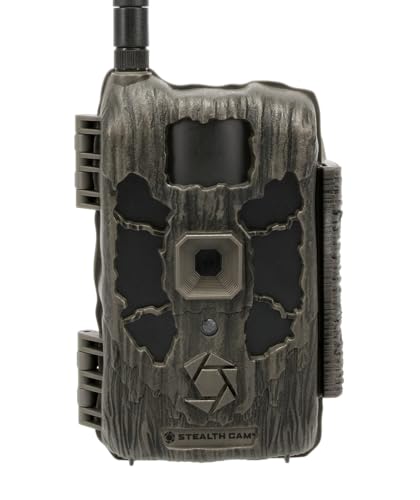
Stealth Cam Deceptor Max 2.0 40MP Camera
A Breakdown Of The Leading Choices
A camera can miss an entire sequence simply because a strap loosens or the viewing angle no longer matches the trail. The Camojojo bracket gives supported cameras a more adaptable position, with horizontal and vertical adjustment designed for trees, walls, and posts.
The 1/4-20 threaded insert provides a familiar mounting point for compatible equipment. Unlike the ground stake in the HME Trail Camera Holder, this bracket favors repositioning an already mounted camera rather than placing it directly in soil.
What Helps Most
- Horizontal and vertical adjustment helps center activity within the frame.
- The included strap supports attachment to trees without a complex frame.
- Six screws and an Allen wrench cover the basic installation tasks.
- Its mounting guide makes bracket setup easier for first-time users.
Minor Gripes
- Compatibility depends on the camera having a compatible 1/4-20 mounting point.
- Tree surfaces require periodic strap checks because wind and growth can loosen contact points.
Quick Facts
Made For
Tree-mounted users and field scouts who need frequent angle adjustments without rebuilding an entire support.
Consider Something Else When
The HME Trail Camera Holder suits open ground placements where a compact ground stake is more useful than tree fastening.
Open crossings and game trails benefit from broad coverage, and the Revolver PRO uses a 360-degree rotating design to reduce blind spots around its mounting point. One camera can cover several directions, which is more useful than repeatedly repositioning a fixed-view model.
Cellular transmission adds remote access, while the stated 40MP photo resolution and 1440p video recording target detailed captures. Compared with the Camojojo mounting bracket, this is a complete monitoring unit, but cellular service and field power become part of the setup.
What Makes Sense
- The rotating body covers a full panorama from one mounting point.
- Day-and-night recording supports continuous wildlife monitoring.
- 40MP stills preserve detail in close wildlife activity.
- Cellular upload removes the routine of retrieving an SD card.
- A stated 0.4-second trigger targets fast-moving subjects.
Practical Considerations
- Cellular reception and a suitable plan may limit remote use in low-signal areas.
- Panoramic rotation can still miss subjects that pass outside the selected detection field.
Key Product Details
Right Fit For
Hunters and property monitors placing connected equipment near open approaches with dependable cellular service.
A Better Fit Elsewhere
The TACTACAM Reveal Ultra 4K Cellular Camera fits connected monitoring that places greater emphasis on live viewing and GPS location tracking.
Remote deployments often fail because disposable cells lose charge faster than expected. The Stealth Cam 12V Battery serves as an external power box for compatible trail cameras, shifting the power burden away from a handful of loose batteries.
This is supporting equipment rather than a camera, yet that distinction matters. A 12V setup may suit a stationary seasonal post better than a lightweight camera carried between locations, and cold conditions remain a factor when selecting any battery system.
What Pays Off
- A wired 12V supply can support longer unattended deployments.
- Centralized power simplifies battery inventory and rotation.
- External power avoids relying entirely on disposable cells in cold weather.
Worth Bearing In Mind
- The battery requires a compatible camera connection and appropriate wiring.
- Fixed installations need cable routing, weather protection, and regular connection checks.
- Carrying the box is less convenient than swapping loose batteries during mobile scouting.
Built With In Mind
Fixed-position users maintaining connected cameras through extended cold-weather or multi-week field deployments.
Reach For A Different Pick When
Lightweight mobile scouts benefit more from a self-contained camera such as the Stealth Cam Deceptor Max 2.0 40MP Camera.
Not every useful camera angle belongs on a tree. The HME Trail Camera Holder is a compact ground post that accepts cameras with a bottom 1/4-20 insert, making it practical for open fields, garden edges, or temporary wildlife crossings.
Its compact shape reduces the visual profile compared with a tall permanent stand. Compared with the Camojojo bracket, the trade-off is simpler placement, but field conditions still determine how securely the post can be driven into the ground.
Real-World Strengths
- The ground stake supports cameras away from trees and walls.
- A 1/4-20 connection suits many standard threaded camera mounts.
- The compact post is easy to reposition between temporary observation sites.
- Rotating the camera onto the threaded end simplifies angle setup.
Soft Spots
- Loose, rocky, or heavily frozen soil can make installation difficult.
- Ground placement needs regular checks because animals, wind, and terrain can shift the post.
- Compatibility ends at the threaded insert, so not every security or trail camera will attach.
Made For
Beginners and field users monitoring open areas where portable ground placement matters more than a tree mount.
Look Elsewhere When
The Camojojo Adjustable Trail Camera Mounting Bracket offers better directional adjustment for trees, posts, and walls.
Remote scouting becomes more immediate with live viewing, high-resolution capture, and cellular image requests. The Reveal Ultra 4K combines those connected functions with GPS location tracking, making it suited to locations where checking activity without walking the entire route matters.
The switchable no-glow and low-glow flash settings offer more control after dark. No-glow reduces visible red illumination, while low-glow provides another option, though local conditions and the need to avoid disturbing wildlife should guide the final setting.
Reasons It Performs
- Live video lets field scouts check conditions without traveling to the camera.
- 4K photos support detailed daylight capture.
- 1080p video records movement in full HD resolution.
- GPS tracking adds useful location information for remote equipment.
- The LCD screen assists with local setup and camera management.
Where It Is Less Suited
- Cellular reception remains essential for live viewing and remote requests.
- The feature set requires a mounted, powered deployment rather than casual handheld scouting.
Feature Breakdown
Who Should Grab It
Connected wildlife observers and hunters who need live confirmation, detailed images, and location tracking from a fixed site.
Another Choice May Suit
The Stealth Cam Revolver PRO 40MP Cellular Camera better fits open terrain where a rotating 360-degree field of view takes priority over an LCD.
The Moultrie Edge 2 focuses on a practical mix of resolution, response, and cellular availability. A stated 36MP still resolution provides detailed daylight images, while 1080p video provides a practical record of movement at fixed locations.
Its multi-carrier connection automatically selects a stronger available signal, which can improve reliability across areas with uneven coverage. Unlike the TACTACAM Reveal Ultra 4K, the Edge 2 emphasizes straightforward capture and integrated storage rather than a front-facing LCD.
Well-Handled Touches
- 36MP stills preserve useful detail in close wildlife images.
- A stated 0.4-second trigger reduces delay around fast subjects.
- Multiple capture modes support different monitoring priorities.
- Automatic carrier selection helps maintain cellular connectivity.
- Built-in memory removes the need for a separate SD card.
Trade Offs
- Cellular performance still depends on nearby network coverage.
- Integrated storage needs periodic management to avoid filling available capacity.
The Right Fit
Property monitors and wildlife observers who prioritize detailed capture, fast triggering, and flexible carrier selection.
Where Another Pick Shines
The TACTACAM Reveal Ultra 4K Cellular Camera better fits setups where live viewing, GPS tracking, and local LCD control are central.
The Deceptor Max 2.0 places processing speed and selectable image resolution at the center of its design. Dual-core hardware handles image capture and cellular upload simultaneously, which is useful during busy periods with several animals crossing the detection zone.
Photo resolution can be set at 4MP, 8MP, 16MP, or 40MP, allowing storage and detail needs to be balanced more carefully. The 40MP setting favors close detail, while 1440p video provides a higher-resolution alternative to standard definition footage.
Benefits That Matter
- Selectable resolution helps balance image detail against file size.
- Dual-core processing supports simultaneous capture and uploading.
- The 40MP option captures detailed close-range subjects.
- 1440p video records movement with more visual information.
- Integrated processing reduces the need for separate capture devices.
Possible Compromises
- The highest resolution setting can produce larger files that require more storage capacity.
- Cellular deployment still requires dependable reception and regular power management.
- The advanced feature set adds more complexity than a basic fixed camera.
Technical Highlights
Who Will Love This
Connected field users who want selectable photo resolution, cellular uploads, and higher-detail video in one camera.
Swap It Out When
The Moultrie Edge 2 Cellular Camera fits monitoring setups that value built-in memory and automatic multi-carrier selection.
What Matters Before Choosing A Field Camera
Start with the deployment site. A tree near a narrow trail, an open property corner, and a remote ridge require different mounting and coverage decisions. Resolution matters less when the camera points into empty brush or sits beyond reliable cellular reception.
Power planning is equally important. Disposable cells are convenient for mobile use, while an external 12V supply can suit a fixed post. Long deployments also need a realistic maintenance schedule for charging, storage checks, cable connections, and weather exposure.
Night behavior should match the location. No-glow and low-glow settings can help limit visible red illumination, although a longer infrared range may be more useful in open terrain. A distant placement often benefits from a tighter detection field rather than an excessively wide view.
For connected models, live viewing and remote uploads depend on cellular service. I consider local carrier compatibility and a steady power source before focusing on megapixel counts. Image quality matters, but accurate positioning and reliable recording come first.
Costs And Capabilities Worth Comparing
What Separates Premium From Basic
Premium cameras tend to add cellular transmission, live viewing, higher selectable resolution, wider network compatibility, or integrated storage. Those features reduce the need to travel to the camera, yet they also create service, power, and configuration considerations.
The upgrade pays off for fixed sites that are difficult to reach frequently. Basic cameras remain sensible for close-range monitoring, lighter mobile use, and placements where the main goal is straightforward local recording.
Frequently Asked Questions
Are high-resolution cameras always better?
Higher resolution can reveal more detail, but positioning and lighting still control the result. A correctly aligned camera often produces more useful images than a higher-resolution model aimed at the wrong area.
Do cellular trail cameras work without a signal?
They record locally, although cellular viewing and remote uploads depend on reception. Checking carrier coverage before installation prevents disappointment in remote locations.
Is a 12V battery box better than loose batteries?
An external 12V supply suits fixed installations and extended deployments. Loose batteries remain easier to carry and replace during mobile scouting.
What mounting style works best?
Trees and walls favor straps or brackets, while open ground benefits from a stake or post. Installation strength and a compatible 1/4-20 connection matter more than the mounting style itself.
Is a no-glow flash suitable for close wildlife monitoring?
No-glow reduces visible red light, which can be useful in sensitive settings. Range and image quality still depend on the camera, subject distance, and infrared illumination.
Final Take
The Stealth Cam Revolver PRO stands out for panoramic coverage, while the TACTACAM Reveal Ultra and Moultrie Edge 2 serve distinct connected-monitoring needs. The Deceptor Max 2.0 emphasizes processing and selectable resolution, and the Stealth Cam battery box and two holders address dependable placement and power. Matching the camera to the terrain is more important than chasing a single headline specification.