
A solid hunting backpack quietly carries half your camp: optics, layers, snacks, water, calls, and on a good day, a heavy load of venison on the way home. The wrong one digs into your hips at mile three and leaves you cursing every slope. The right one disappears on your shoulders, swallows your gear whole, and stays quiet when a buck is fifty yards out. This roundup compares eight real options across price tiers and use cases, from lightweight day packs to heavy-hauling Badlands rigs. You’ll find the strengths, trade-offs, and honest fits for each, so you can match the pack to your terrain, your weapon, and how far you plan to roam.
A Fast Comparison Of The Options

Badlands 2200 Hunting Pack with Meat Hauler

YVLEEN Waterproof Camo Day Pack

TIDEWE Hunting Backpack for Men, 40L

BLISSWILL Large Hunting Backpack 40L
BLISSWILL Hunting Backpack Day Pack

Badlands ATX Tactical Hunting Pack

Badlands Superday Hunting Backpack
BLISSWILL Silent Fabric Hunting Backpack
More On The Choices That Made The List
The Badlands 2200 is the pack you strap on when you know you’ll be packing meat out on foot. The built-in meat hauler is a real engineering choice, not a marketing add-on, and the molded memory foam suspension is designed to get more comfortable as the harness conforms over time. The waist belt pulls inward rather than outward, which gives you natural leverage to cinch it tight under load.
That frame and suspension setup earns its weight when you’re humping sixty pounds of boned meat down a mountain. Compared to the lighter day packs below, this is firmly an expedition-grade rig, and it expects to be loaded hard.
What Pays Off
- Built-in meat hauler that genuinely changes how you pack out game
- Molded memory foam suspension that softens and conforms over weeks of use
- Inward-pull waist belt that lets you cinch tight without straining
- Frame designed for carrying 50+ pounds without bottoming out on your hips
- Air-textured paneling that reduces hot spots on long uphill climbs
Trade-Offs To Consider
- Heavier and bulkier than a day pack, so overhunting on short trips feels like overkill
- Larger frame can snag in tight timber and dense brush
Built With In Mind
Western elk and mule deer hunters logging multi-mile packouts on foot.
Look Elsewhere When
The Badlands Superday fits a quick morning sit far better than the 2200 does.
The YVLEEN packs a rifle or bow holder, dedicated gear compartments, and a camo shell into one affordable package. It’s the kind of bag that gets the new hunter out the door without overthinking the gear list. The integrated weapon carry system means your hands stay free for gloves, calls, and a trekking pole.
Where the Badlands 2200 above is built for hauling meat, this is a starter rig designed for short sits and weekend hunts. You get a thoughtful layout at a price that lets you upgrade other essentials.
Useful Touches
- Integrated rifle and bow holder that frees your hands
- Waterproof camo shell that handles drizzle and morning dew
- Multiple organizational pockets so rangefinders and calls stay separate
Honest Caveats
- Build materials won’t match the long-haul toughness of premium packs
- Limited internal volume compared to the 40L rigs on this list
- Zippers and stitching may wear faster under heavy loads
Quick Technical Notes
Right Fit For
First-season hunters who want one pack that handles rifle or bow without buying extras.
Reach For A Different Pick When
The TIDEWE 40L is a smarter call for longer days with more gear.
The TIDEWE 40L lands at a sweet spot: light enough to stalk in with, roomy enough to carry layers, optics, water, and a snack for a long sit. The high-performance polyester shell keeps weight down near 3.7 pounds, which matters when you’re walking miles before glassing a ridge.
The multi-pocket layout is genuinely useful in the field, not just marketing copy. Side mesh pockets hold a water bladder hose, hip belt pockets keep rangefinder batteries handy, and a wide main compartment swallows your rain shell. For most deer hunters, this is a sensible middle-ground choice.
A Few Strong Suits
- 40L capacity that handles a full day of gear without bulging
- Lightweight 3.7-pound build that won’t wear you down on long approaches
- Quiet polyester shell that doesn’t crinkle loudly under movement
Points To Keep In Mind
- No integrated rifle bow carry system like the YVLEEN offers
- Polyester shell resists light rain but isn’t fully waterproof in storms
Best Suited To
Spot-and-stalk whitetail hunters covering ground on foot.
A Better Fit Elsewhere
The BLISSWILL 40L with padded weapon carry suits rifle hunters who want built-in scabbard support.
The BLISSWILL 40L with padded weapon carry is built around a different problem than the TIDEWE above: protecting a scoped rifle or riser while keeping your hands free. The padded scabbard compartment absorbs shock from branch contact, which matters when you’re pushing through thick oak brush or scrambling over a blown-down tree.
At 40 liters of storage, it’s right in the sweet spot for full-day hunts. The honest trade-off is that the weapon compartment eats some interior space, so packing capacity is more limited than the spec suggests.
Notable Gains
- Padded weapon carry that protects optics and limbs from impact
- 40L overall capacity suitable for full-day loads
- External attachment points for tripod, jacket, or trekking poles
Potential Drawbacks
- Weapon compartment reduces usable interior space for general gear
- Heavier than non-padded packs when fully loaded
Feature Rundown
Who Should Grab It
Rifle hunters who push through thick cover and want their scope protected.
Where Another Pick Suits Better
The Badlands ATX is the smarter pick for hunters who prefer a smaller, modular setup.
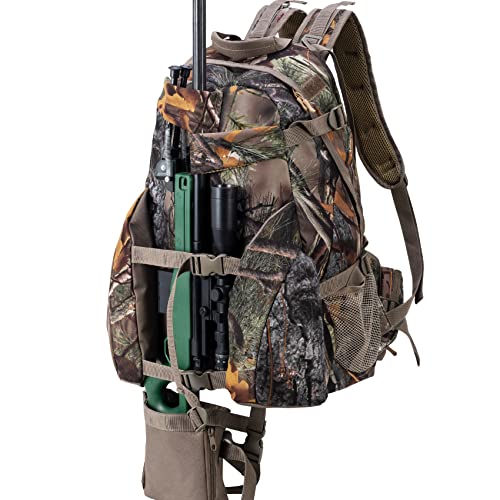
This BLISSWILL day pack leans into the quiet-hunt essentials without piling on features you won’t use. The waterproof, soundless fabric is the headline trait, and it’s paired with a compass on the shoulder strap and an emergency whistle on the chest harness, small touches that give new hunters one less thing to forget.
The dimensions around 21 by 15 by 10 inches and roughly 1.4-kilogram weight make it comfortable for short sits. It’s a friendly entry point, and unlike the bulkier 40L rigs above, it doesn’t feel like a hump on a half-day outing.
Points In Its Favor
- Waterproof soundless fabric that stays quiet when you shift positions
- Built-in compass for backup navigation in unfamiliar terrain
- Emergency whistle integrated into the chest strap for quick signaling
- Lightweight 1.4 kg build that won’t wear you down on short hunts
Less-Strong Areas
- Smaller volume than the 40L packs above, so it’s not a long-hauler
Made For
New hunters who want safety basics and a quiet pack for half-day sits.
Skip It When
The TIDEWE 40L is a better choice for hunters who carry extra layers and optics.
The ATX is the smallest and lightest pack in Badlands’ All-Terrain Xtreme series, designed for hunters who want the brand’s build quality without hauling a full expedition rig. It’s fully water-resistant, tough enough for rough terrain, and modular in ways most packs on this list aren’t.
Compatibility with Badlands hydration reservoirs, SWAP accessories, and Bino Connect harnesses means the ATX grows with your kit. Add a chest pouch here, swap a bino harness there, and the pack adapts across seasons. Compared to the BLISSWILL day pack above, this is a noticeable step up in materials and ecosystem.
Positive Points
- Compact and light, the smallest pack in the ATX lineup
- Water-resistant shell that handles wet brush and morning frost
- Compatible with Badlands SWAP and Bino Connect accessories
- Modular design that scales up or down based on hunt length
Small Caveats
- Smaller capacity limits how much you can pack for a full day
- Modular accessories often sold separately, adding to total spend
Feature Snapshot
Perfect Match For
Mobile hunters who want a light, modular pack they can scale over time.
Not Your Match When
The Badlands 2200 is the right call if you plan to haul meat out on foot.
The Superday is Badlands’ take on a no-nonsense day pack. It’s the middle child between the compact ATX above and the expedition-grade 2200, sized for hunters who want brand reliability without a frame and meat hauler they won’t use.
It’s the kind of pack you throw in the truck for a morning sit, a scouting hike, or a quick range session. The build quality reflects the brand’s reputation, and you can expect the same suspension thinking as larger Badlands packs, just in a smaller package.
Noteworthy Benefits
- Trusted Badlands construction in a versatile day-pack size
- Comfortable suspension tuned for moderate loads
- Practical size for scouting trips, range days, and short hunts
A Few Limitations
- No meat hauler or full-frame support for heavy loads
- Less modular than the ATX if you want accessory customization
Whose Shelf It Belongs On
Hunters who run a quick morning sit or scouting loop most weekends.
Swap It Out When
The YVLEEN is a more affordable pick if you also want rifle or bow carry.
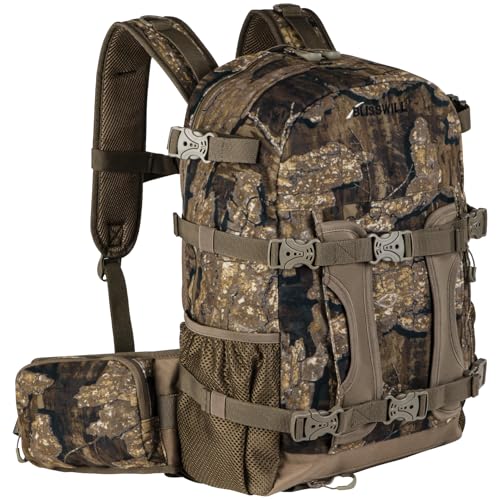
The flagship BLISSWILL pack on this list is built around stealth. The 1000D silent-weave fabric, paired with a TPU waterproof coating, is engineered to suppress the rustle and crinkle that gives away still hunters. Silent zippers and noise-suppressing materials carry that theme across every contact point.
For hunters who set up close and count on remaining undetected, fabric noise matters more than most specs suggest. The shell is also tear-resistant and built for rough weather, so the stealth design doesn’t trade off durability.
Everyday Wins
- 1000D silent-weave fabric that minimizes movement noise
- TPU waterproof coating for wet conditions and morning frost
- Silent zippers throughout to avoid giveaway clicks
- Tear-resistant construction that handles thorny cover
Things To Weigh
- Stealth-first design may cost more than a basic camo pack
- Heavier fabric adds weight compared to ultralight day packs
Core Details
Who Will Love This
Still hunters and bowhunters who rely on silence to close the distance.
Consider Something Else When
The TIDEWE 40L is a lighter, more affordable choice for spot-and-stalk style hunting.
Matching Your Pack To The Way You Hunt
Hunting backpacks look similar on a shelf, but they punish you differently in the wrong setting. Capacity is the first fork in the road: day packs in the 20 to 30-liter range handle a sit, a snack, and a layer, while 40-liter rigs swallow rain gear, optics, and a full water reservoir for long stalks. If you’re packing meat out on foot, capacity alone won’t save you; you want a frame and a meat hauler, which is the whole reason the Badlands 2200 exists.
Weapon carry is the second decision. Rifles and bows change how the load sits on your body, and a padded scabbard or external carry system keeps your hands free and protects optics. The BLISSWILL 40L and YVLEEN both lean into this, while the TIDEWE assumes you’ll sling your weapon separately. For still hunters, fabric noise matters more than most specs suggest, and silent-weave construction like the BLISSWILL stealth pack can quietly out-perform louder, lighter designs when game is close.
Modularity is worth weighing if you see yourself upgrading over time. The Badlands ATX is the clearest example here, with SWAP-compatible accessory points and Bino Connect harness integration. That ecosystem is real value if you’ll keep the pack for years. If you’re buying your first pack, simpler is often smarter; the BLISSWILL day pack’s compass and whistle are practical without overcomplicating things.
Things To Consider Before You Buy
Pitfalls Shoppers Hit
The biggest mistake is buying by liter count alone. A 40-liter pack with a built-in rifle scabbard has less usable interior space than a 40-liter pack without one, and that gap shows up when you’re stuffing a rain shell and optics inside. Another common slip is ignoring fabric noise; many affordable packs use crinkly nylon that sounds like a snack bag in dry leaves. Test by gently scrunching the fabric before you buy if stealth matters.
Sizing is the third trap. Torso length and waist belt fit matter more than total volume, and most packs run medium-large on their default settings. A pack that doesn’t sit on your hips will throw weight onto your shoulders, and you’ll feel every mile. Finally, don’t assume waterproof means submersible; most hunting shells handle rain and dew but soak through in heavy downpours or stream crossings.
Where The Extra Money Goes
Premium-tier hunting backpacks cost more because of materials and frame engineering. Aircraft-grade aluminum stays in the Badlands 2200 keep heavy loads stable instead of letting them sway with each step. The suspension systems, like molded memory foam, are designed to conform to your body, so they actually improve with use rather than breaking down. Silent-weave fabrics are a quieter technical achievement than they appear; the weave and finish have to suppress rustle without sacrificing tear strength.
The upgrade pays off when you hunt hard and often: multi-mile packouts, week-long trips, and rough terrain where a frame failure means a ruined hunt. For occasional day hunts from a truck or short walks to a stand, a mid-range pack delivers most of the value without the premium price.
Frequently Asked Questions
How big should my hunting backpack be?
For day hunts from a stand or short stalks, a 25 to 35-liter pack handles everything you need. For full-day hunts with layers, optics, water, and food, 40 liters gives breathing room. Multi-day trips and meat-hauling demand 50 liters or more plus a frame.
Do I need a rifle or bow carry system?
Built-in weapon carry is useful if you push through thick cover or want your hands free for calls and trekking poles. Spot-and-stalk hunters who sling their rifle separately often skip it. Bowhunters usually prefer external or sleeve systems to protect limbs.
What is silent-weave fabric?
Silent-weave is a tightly woven fabric, often 1000D or similar, designed to suppress rustle and crinkle when you move. It costs more than basic nylon but pays off when game is close and any noise spooks your shot.
Are waterproof hunting backpacks really waterproof?
Most are water-resistant, meaning they handle rain, dew, and snow for hours. Submersible waterproofing is rare and usually means a roll-top or welded-seam design. For stream crossings and downpours, pack important electronics in dry bags inside the pack.
How do I clean a hunting backpack?
Brush off dirt and debris after each trip, then hand wash with mild soap and lukewarm water. Avoid machine washing and harsh detergents, which break down fabric coatings and weaken seams over time. Air dry completely before storing to prevent mildew.