
Glassing a treestand line at dawn is the kind of job that punishes cheap optics and rewards the right pair. Whether you still-hunt whitetails in heavy brush or push deeper into open western country, your binoculars decide how much of the field you actually see before you draw. This lineup pairs traditional 10×42 roof-prism binos with laser rangefinder hybrids, so you can match glass to the way you actually hunt.
A Closer Look At The Lineup

Vortex Diamondback HD 10×42 Binoculars

Gogogo Sport Vpro GS06 Hunting Rangefinder 1200 Yards
Gogogo Sport Vpro Green Hunting Rangefinder 1200 Yards

Bushnell 10x42mm Trophy XLT Binoculars

Gogogo Sport Vpro Golf Range Finder 900 Yards

Gogogo Sport Vpro Range Finder Golf/Hunting 1500/2500 Yards

Vortex Crossfire HD 10×42 Binoculars

Gogogo Sport Vpro GS24 Golf and Hunting Rangefinder 1200 Yards

Gogogo Sport Vpro Rangefinder Binoculars 8×42 1500 Yards
Why These Options Stand Out
The Diamondback HD sits in a comfortable middle ground that bowhunters tend to land on year after year. The 10×42 roof-prism format, where the internal prisms align in a straight tube, pulls distant cover into focus without making a full day of glassing feel shaky, while the 42mm objective lenses gather enough light for those last twenty minutes of shooting light. Compared to the rangefinder hybrids further down this list, this is a pure optical tool, which is exactly why so many hunters keep one strapped to their chest harness from early season velvet to late-season muzzleloader.
You get a fully multi-coated optical path (multiple anti-reflective coatings on every glass surface) for cleaner color and edge-to-edge sharpness, and the armored housing is built to handle brush, pack straps, and the occasional tree-stand ladder bump. Most owners find the focus wheel smooth enough to run with a single gloved finger, which matters more than it sounds when a buck steps out and you need to refine the picture fast.
Good Reasons To Consider
- 10x magnification paired with a forgiving 42mm objective for steady, low-light friendly glassing across an entire sit.
- Fully multi-coated lens stack trims chromatic fringing (color halos around high-contrast edges) on antler tines against open sky.
- Armored, non-slip chassis handles wet mornings and cold-metal treestand rails without feeling fragile.
- Wide enough apparent field of view to pick up movement in peripheral cover, useful for still-hunting in tight timber.
- Twist-up eyecups that hold adjustment well, so glassing with eyeglasses stays comfortable over long sessions.
Things To Consider
- At 10x, you will notice handshake at the end of a long sit unless you brace against a tree or shooting rail.
- It is a dedicated bino, not a rangefinder hybrid, so pairing it with a separate laser unit adds bulk and weight to the kit.
Feature Snapshot
Who It Suits Best
Whitetail and mule deer bowhunters who glass from a fixed stand or slow stalk and want a do-it-all optic without paying flagship prices.
Where Another Pick Suits Better
Run-and-gun western archers chasing sheep or goats in open basins will get more from the Gogogo Sport Vpro Range Finder for Golf/Hunting with Slope, 1500/2500 Yards, since the laser cuts the guesswork out of steep downhill shots.
The GS06 is the kind of rangefinder that quietly finds a home in a lot of first bowhunting kits. You are getting a 1200-yard class 1 laser (a low-power, eye-safe laser type) and 6x magnification in a palm-sized unit, which is plenty for shooting lanes inside a hundred yards. Compared to the Vortex Diamondback HD covered above, this thing trades optical bulk for a numeric readout, and that trade actually makes a lot of sense for stand hunters who already carry dedicated glass.
Three target modes cover the basics: standard distance, scan, and a flag-lock style function. Bowhunters working pasture edges and food plots will find the speed adequate, and the simple two-button layout means you are not fumbling through menus when your target is already moving.
Real-World Strengths
- Lightweight body that drops into a jacket pocket or chest harness without a fight.
- Three measurement modes keep the controls simple enough for cold, gloved hands.
- 1200-yard ceiling handles open field setups where you might tag a deer walking in at long range.
- Eye-safe class 1 laser rating means no extra safety steps during pre-season sight-in days.
Worth Noting
- Reflective surfaces beyond about 600 yards can return erratic readings in low-contrast conditions, a common trait for budget lasers.
- 6x magnification is useful but feels modest when you are trying to confirm a target at the edge of a clearing.
- No built-in angle compensation, so steep uphill or downhill shots still need a holdover mental math step.
Made For
New bowhunters who mainly hunt flat to moderately sloped terrain and want a low-fuss distance tool without overspending.
Consider Something Else When
Western hunters packing into steep canyons will get more honest yardage from the Gogogo Sport Vpro GS24 Golf & Hunting Laser Rangefinder, 1200 Yards, thanks to its built-in angle compensation.
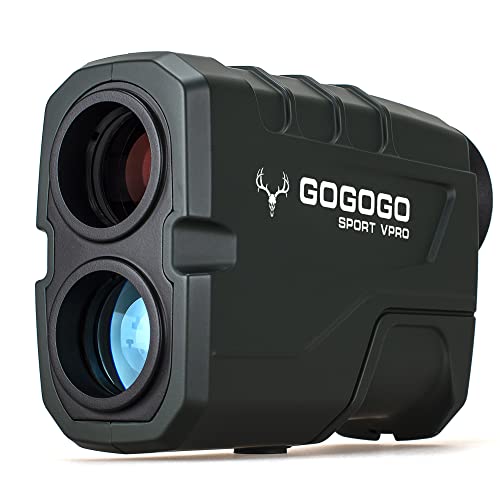
The green-display version of the GS-series swaps the traditional red readout for a high-contrast green LCD, and for many bowhunters that is the whole story. Green text reads cleanly against shadowy woods and dusk-lit corn, where red can wash out and force you to squint. You get the same 1200-yard range, 6x magnification, and class 1 laser that you find across this Gogogo line.
For archers just stepping up from borrowed gear, the simplified three-mode switch keeps the learning curve short. Mode 1 covers standard distance plus horizontal and angle readouts, which is genuinely useful when you are still dialing in your holdover references.
A Strong Showing
- Green display layer tends to be easier on the eyes during long dusk-to-dark sits.
- Horizontal distance and angle readouts in Mode 1 take a lot of the math out of treestand shots.
- Stable readings up to the full 1200-yard rating, with around plus or minus 1 yard accuracy at typical hunting distances.
- Pocket-friendly footprint that pairs well with a lightweight bino like the Vortex Crossfire HD covered later.
Trade Offs
- Green display uses a bit more battery than a comparable red screen, so carrying a spare CR2 is smart on multi-day trips.
- Target acquisition slows in fog or heavy rain, which is true of any laser but worth knowing before committing to a shot.
Right Fit For
Early-season hunters who spend more evenings in the stand than mornings and want a display that stays readable as the light fades.
Skip It When
Stand hunters who already own a quality bino and mostly need long-range reach should look at the Gogogo Sport Vpro Range Finder for Golf/Hunting with Slope, 1500/2500 Yards for a much longer laser envelope.
Bushnell’s Trophy XLT has been a quiet workhorse in the hunting world for a long time, and the 10×42 configuration keeps that reputation intact. The 6.2-degree angle of view is the headline number here: that translates into a noticeably wider field of view than tighter roof-prism binos, which makes scanning big food plots and oak flats feel less like searching through a straw. Compared to the Vortex Diamondback HD reviewed earlier, this is a more sweep-friendly glass built for the kind of country where movement shows up anywhere and everywhere.
The waterproof housing shrugs off the kind of damp mornings that ruin lesser optics, and the rubber armor keeps the chassis quiet against rifle and bow stocks. You can run the Trophy XLT hard from August velvet scouting all the way through late muzzleloader season without feeling like you baby it.
Why It Works Well
- 6.2-degree field of view is generous, making it easier to track a moving buck across an open field.
- Waterproof construction handles wet, brush-heavy hunts where fogging and seepage would sideline other glass.
- 10×42 sizing is the classic sweet spot for bowhunters who want reach without giving up low-light performance.
- Solid, rubber-armored body that does not clang against aluminum treestand steps.
Some Limits To Know
- Edge sharpness is softer than the Vortex HD options in this lineup, especially toward the outer thirds of the image.
- Focus knob is smooth but a touch stiff out of the box; it loosens up after a season of regular use.
Quick Facts
Who Should Grab It
Hunters who bounce between spring turkey scouting, summer velvet checks, fall deer sits, and winter bird watching with the same pair of binos.
Look Elsewhere When
Bowhunters who prefer a single dedicated optic can save a few dollars with the Vortex Crossfire HD 10×42 Binoculars while still getting reliable HD glass for the same scenarios.
On paper this looks like a golf rangefinder that wandered into the hunting aisle, but the features translate surprisingly well to a bowhunter’s life. The 900-yard laser ceiling covers every whitetail scenario most archers will see, and the 0.5-second measurement speed keeps things moving when a buck does not stand still. Where this unit separates itself is the magnetic body strip and the built-in rechargeable battery, both of which are rarities at the price.
Slope-on and slope-off modes are controlled by a physical switch, so you can turn compensation on for practice and off for tournament-legal play without diving into menus. The pin-lock vibration is a small touch that helps confirm a reading in the field without staring at the screen.
Noteworthy Benefits
- Magnetic strip keeps the unit stuck to a truck cab or metal tree hook between glassing sessions.
- USB-C rechargeable battery with up to 20,000 measurements per charge cuts down on disposable battery costs.
- Slope switch toggles instantly, which doubles the unit’s usefulness for both archery practice and real-time hunting.
- Vibration feedback on pin lock gives a clear yes/no read when you grab a distance on a small target.
Points To Note
- 900-yard ceiling is shorter than the longer Gogogo models in this list, so very open-country hunters may push the limit.
- Magnetic mount is convenient, but the unit can pick up metal clangs against your stand if you carry it loose.
Best Suited To
Archers who split their time between the bow range and the deer woods and want one rechargeable unit that handles both chores.
A Better Fit Elsewhere
Hunters who only ever use the rangefinder in the field will find the Gogogo Sport Vpro GS24 Golf & Hunting Laser Rangefinder, 1200 Yards more purpose-built with proper angle compensation.
This is the unit you reach for when the country gets big. The 1500-yard reflective range (and 2500 yards to highly reflective targets) puts real distance in your hands, and the 7x magnification pulls a long reading into focus better than the 6x models earlier in this list. The slope switch sits right where your thumb wants it, so you can flip compensation on for hunting and off for tournament play without breaking your grip.
For western bowhunters chasing muleys in basin-and-ridge country, or anyone glassing big alfalfa fields at first light, the extra reach turns into a real tactical advantage. The 0.38-second read time is also one of the faster figures in this Gogogo family, which is noticeable when an animal is moving and you only get one clean window to range.
The Value In It
- 7x magnification gives a cleaner, larger image at distance than 6x units, helpful for confirming small targets.
- 0.38-second read time keeps pace with walking animals rather than locking you into static shots.
- Slope switch is mechanical, so it cannot be bumped into the wrong mode by accident in a chest pocket.
- 1500-yard reflective range handles open-country scouting and long shooting lane estimation.
Where It Is Less Suited
- Bigger chassis than the 6x Gogogo models, so it is less comfortable in a small jacket pocket.
- Long-range precision is great, but reflective surfaces in fog or snow can occasionally bounce a stray number into the display.
Spec Overview
Perfect Match For
Western archers and big-woods bowhunters who range across basin-sized shooting lanes and need more reach than a typical 1200-yard unit.
Swap It Out When
Stand hunters working tight oak ridges will not use the extra reach and may prefer the lighter, simpler Gogogo Sport Vpro GS06 Hunting Rangefinder, 1200 Yards reviewed earlier.
The Crossfire HD is the optic that pulls a lot of bowhunters out of the bargain-bin aisle for good. It carries Vortex’s HD optical designation, meaning the glass has been engineered to reduce chromatic aberration (color fringing on high-contrast edges) compared to standard lenses, and the 10×42 format mirrors the more expensive Diamondback HD reviewed above. Side by side, you give up a touch of low-light brightness, but the everyday image is sharp enough that most hunters will not notice.
The included GlassPak harness is a real perk for run-and-gun bowhunters, since it keeps the binos snug against your chest and ready to deploy without a loud nylon flap. The rubber armor takes pack strap abuse without complaint, and the focus wheel moves with the kind of confidence that makes a quick deer scan feel natural.
Positive Points
- HD glass system sharpens color and trims fringing, which helps with antler and body detail at distance.
- GlassPak harness included in the box, so you can clip them up and go without buying extra accessories.
- Lightweight enough to wear all day on a chest rig without neck fatigue.
- Twist-up eyecups click solidly into position for eyeglass wearers.
Possible Compromises
- Low-light transmission is slightly behind the Diamondback HD in the same lineup, so the very last 15 minutes of legal light are less forgiving.
- The GlassPak harness is comfortable but can absorb scent, which means an occasional unscented wipe-down between sits.
Who Will Love This
Budget-conscious bowhunters who want HD-class glass and a usable harness right out of the box, with room to grow into the hobby.
Another Choice May Suit
Whitetail hunters who prioritize the widest possible field of view for scanning open food plots may find the Bushnell 10x42mm Trophy XLT Binoculars a better sweep tool.
The GS24 is the most feature-dense unit in this Gogogo family, and the one that bowhunters working hill country tend to gravitate toward. It carries the company’s angle range compensation, often called ARC, which adjusts the line-of-sight distance you see on the screen into a more useful horizontal yardage for archery. For treestand hunters in ridge-and-hollow terrain, that single feature is the difference between guessing and knowing.
Beyond the slope math, the GS24 offers continuous range readings for scanning and a target priority mode that prefers closer objects over background trees. The 6x optic and 1200-yard ceiling keep it in the same general weight class as the GS06 reviewed earlier, but the on-screen data is much richer.
What Helps Most
- Angle range compensation removes a layer of mental math from uphill and downhill shots.
- Continuous scan mode tracks a moving target so you are not chasing one button press.
- Target priority mode reads the nearest object, which avoids accidentally ranging tree trunks behind a deer.
- Affordable price point relative to flagship laser units with the same compensation feature.
Practical Considerations
- The display packs a lot of numbers into a small area, so it takes a few range sessions before you can read it without slowing down.
- Like other 6x units, long-range target identification is not as confident as 7x or 10x binos.
Built With In Mind
Archery hunters working steep timber, river bluffs, and mountain edges where true horizontal distance is the number that matters for pin gaps.
Reach For A Different Pick When
Stand hunters who already own a quality bino like the Vortex Diamondback HD may only need a basic laser, making the Gogogo Sport Vpro GS06 Hunting Rangefinder a simpler match.
The hybrid at the bottom of the list pairs a fully multi-coated 8×42 binocular with a built-in laser rangefinder, which is the kind of “one tool does both” setup that some bowhunters love and others skip. The 8x magnification is a smart compromise: enough reach to confirm a target and enough stability to glass handheld for extended periods, with a 1500-yard range ceiling for distance work.
Carrying a single unit instead of a bino and a separate rangefinder cuts weight and reduces fumbling at the moment of truth, which is genuinely valuable from a fixed stand. The trade-off shows up in the optical purity: hybrid units rarely match a dedicated 10×42 bino for low-light clarity, but they get close enough for most hunting hours.
Key Advantages
- Combines spotting and ranging in one chassis, trimming your kit down to a single neck strap.
- 8x magnification strikes a useful balance between image size and glassing stability for older eyes or steady hands.
- 1500-yard range covers nearly every bowhunting scenario east or west.
- Fully multi-coated optics help maintain contrast in shaded timber and dusk windows.
Details To Watch
- Hybrid chassis tends to be heavier than a standard 10×42, which can wear on the neck during long, slow sits.
- Glassing at the same 8x as the rangefinder is comfortable, but you give up the reach of the Vortex Diamondback HD for distant scanning.
Feature Card
Whose Shelf It Belongs On
Bowhunters who want a single glass-and-range tool for travel, public land, or backcountry hunts where weight and pack space matter.
Where A Sibling Pick Shines
Hunters who already have a quality rangefinder and want the brightest possible glass for legal shooting light will get more from the Vortex Diamondback HD 10×42 Binoculars reviewed at the top of this list.
What Matters Most Before Choosing Binoculars For Bow Hunting
Magnification And Objective Size
Magnification and objective lens size, the second number in a spec like 10×42, define how a binocular feels in the field. A 10×42 setup pulls distant cover close enough to read antler shape and body posture, while 8×42 stays steadier for longer glassing sessions and gives older eyes a slightly larger exit pupil (the cone of light that reaches your eye, calculated as objective divided by magnification). For most bowhunting, the 8x to 10x range with 42mm objectives covers every realistic scenario.
Coatings, Prisms, And Low-Light Performance
Fully multi-coated lenses and HD or extra-low-dispersion glass (special glass that reduces color fringing) do most of the heavy lifting for low-light clarity, the kind you want during the last fifteen minutes of legal shooting light. Roof-prism designs keep the tube slim for harness carry, while porro-prism designs (where the barrels are offset from the eyepieces) can deliver a wider field of view at a lower price but a bulkier shape. Whichever route you pick, the rubber armor and nitrogen-purged waterproofing matter more than most shoppers expect the first time they sit through a sideways rain.
Rangefinder Features That Matter
If you choose a hybrid or a separate laser, look for the features that map directly to bowhunting use. Angle range compensation adjusts line-of-sight distance to a true horizontal distance, which is the number your sight pins are dialed to. Target priority modes help avoid ranging background trees instead of the deer, and a fast read time, around half a second or quicker, keeps you in the shot sequence when a buck is moving. Slope-on and slope-off switches are useful for hunters who also practice on a golf course or 3D range.
Key Considerations Across These Picks
Common Shopping Slip Ups
The most common mistake in this category is buying a rangefinder first and skipping real optical quality, only to realize later that the laser tells you a deer is 47 yards away but you still cannot tell whether it is a button buck or a shooter. Equally common is overpaying for a 1500-yard range when your hunting happens at well under 80 yards in tight timber. Match the optic to the cover you actually hunt, not the spec sheet you wish you needed.
Where The Extra Money Goes
The higher tier in this category typically buys better glass, not longer range. Extra-low-dispersion lenses, tighter mechanical tolerances, and better waterproofing show up as sharper edges, less color fringing, and a chassis that survives years of abuse. The upgrade is worth it for hunters who log dozens of sits a season, while a casual weekend archer will rarely notice the difference over a value pick like the Vortex Crossfire HD.
Frequently Asked Questions
What magnification is best for bow hunting binoculars?
Most bowhunters settle on 8x or 10x, with 42mm objectives. 10x gives more reach for open terrain, while 8x is steadier and more forgiving for older eyes or long glassing sessions.
Do I really need a rangefinder in my binoculars?
A rangefinder is most useful when your hunting involves uphill, downhill, or longer shots where guessing distance leads to missed pin gaps. In flat timber with shots under 30 yards, a quality bino alone is enough.
How far should a hunting rangefinder reach?
For whitetail and most eastern setups, 600 to 1000 yards of real-world range is plenty. Western open-country hunters benefit from 1200 to 1500 yards to handle long basin shots and ridge line checks.
What is angle compensation on a rangefinder?
Angle compensation adjusts the line-of-sight distance the laser reads into a horizontal distance, the number your sight pins match. It is essential for any shot with a steep uphill or downhill component.
Are rangefinder binoculars worth the extra weight?
Hybrid bino-rangefinders save you from carrying two units, but they tend to weigh more than a standard 10×42 and rarely match a dedicated optic for low-light clarity. Choose a hybrid for travel and pack space, or a separate pair when optical purity matters most.