
After dark, the world still has plenty to show you. The challenge is gathering usable detail without hauling military-grade hardware, since most folks want gear that fits a weekend trip, a backyard wildlife watch, or a quiet property check. Modern civilian night vision goggles pair digital sensors with infrared (IR) illuminators, invisible to your eye but bright to the sensor, so you can read a trail or scout a campsite in near-total darkness. The eight picks below cover everything from serious long-range observation to a kid-friendly option and even a non-functional cosplay prop. Each one has a real role to play, depending on what you’re planning.
A Fast Comparison Of The Options

Tezousi Night Vision Goggles 4K 10X Digital Zoom
WOSPORTS 4K Night Vision Goggles 80X Magnification

Jeekootoop Dummy Night Vision Goggles Helmet Mount

HURYSIN Night Vision Goggles Binoculars with Grip

Rumyums Night Vision Goggles for Kids 4K

Tizycod Compact Night Vision Binoculars

Tizycod 4K Night Vision Goggles for Men and Teens
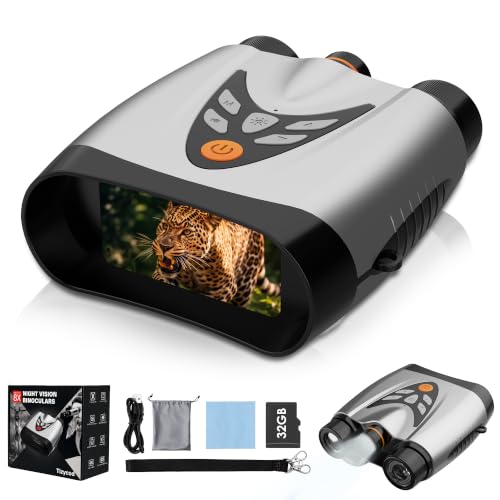
Tizycod Night Vision Goggles 940nm Stealth IR
The Details Behind The Selections
The Tezousi sits in the comfortable middle of the civilian night vision goggles category, and for most people that’s exactly where it belongs. It pairs a 4K sensor with 10X digital zoom and a manual focus ring, so you can dial in clarity on a treestand at dawn or a raccoon raiding the trash at 2 a.m. The 4-inch IPS screen is large enough to share a view with a hunting buddy without everyone squinting at a postage-stamp display.
Range is rated up to roughly 800 meters in low-light conditions, though you’ll get the cleanest image well inside that figure once the IR kicks in. Compared with the pocket-sized Tizycod coming later, this one is heavier and happier on a tripod than in a coat pocket. For a beginner moving up from phone-clip night vision, it’s a sensible first step.
Useful Strengths
- 10X digital zoom with manual focus gives you precise control when scanning distant treelines.
- 4K sensor resolution captures usable stills and video, helpful for documenting wildlife behavior.
- The 4-inch IPS screen is easier on aging eyes than the 3-inch panels found on most competitors.
- Solid build feels stable in the hands during long observation sessions.
Things To Consider
- Heavier than compact alternatives, so plan on a tripod for long viewing windows.
- Maximum range claims assume some ambient light; total darkness shortens effective distance noticeably.
- Battery life varies with IR brightness, and owners commonly report heavy IR use drains cells faster than expected.
Feature Snapshot
Who It Suits Best
Backyard wildlife watchers and casual hunters who want a screen large enough to share with a partner.
Where Another Pick Suits Better
Travelers chasing minimal weight will find the compact Tizycod unit further down this list easier to pack on a long hike.
Where most civilian goggles top out somewhere around 8X or 10X, the WOSPORTS pairs 10X optical with 8X digital zoom, hitting a combined 80X magnification figure. In real terms, that means you can resolve shapes from roughly 1,300 feet away, which is meaningful if you’re scanning a wide clearing or open marsh rather than a tight backyard. The 4K sensor feeds a 3-inch HD screen, smaller than the Tezousi’s panel but still comfortable for solo viewing.
A 64GB TF card ships in the box, which removes the scramble of sourcing your own storage before a first outing. Unlike the kid-focused Rumyums unit further along, this one is built for adults who want range and resolution over cute extras. It’s a serious tool for open-country use.
The Case For It
- 10X optical plus 8X digital delivers the longest reach in this lineup.
- 4K video recording with 48MP photo capture preserves detail for later review.
- Included 64GB card handles long trips without an immediate storage upgrade.
- Expandable storage up to 256GB for multi-day expeditions.
Trade-Offs
- High magnification amplifies hand shake, so a tripod or monopod is essentially required at full zoom.
- 3-inch screen feels modest compared to the 4.5-inch HURYSIN panel covered later.
- Lens cleaning matters more at this zoom level; dust spots become obvious on footage.
Made For
Property owners with large acreage, search-and-rescue volunteers, and hunters working open terrain.
Skip It When
You mainly watch a small backyard or feeder, where the Tezousi’s simpler zoom range will feel less intimidating.
The Jeekootoop is honest about what it is: a non-functional replica modeled after popular PVS-style housings, including PVS15, PVS18, and GPNVG18 form factors. There are no sensors, no IR LEDs, and no electronics inside. You can sort of see through it, but the image is upside down and not usable for actual observation. Its job is to look right on a helmet during airsoft games, milsim events, or Halloween.
Unlike the functional WOSPORTS unit above, this one ships with a helmet mount in the box, so it’s ready to attach to most standard airsoft or bump helmets. Build weight is light enough to wear for an evening skirmish without neck fatigue. For a buyer whose goal is screen-accurate kit rather than real night vision, this is the right category entry.
The Good Stuff
- Three compatible form factors cover the most popular PVS-style shells.
- Helmet mount included, so no extra accessory purchase is needed.
- Lightweight construction stays comfortable during extended wear.
- IPD adjustment (interpupillary distance, the spacing between the two eyepieces) keeps the look dialed in for different face shapes.
Honest Caveats
- No image sensor, so this is not a tool for wildlife or security use.
- Limited upside-down viewing window is a curiosity, not a feature.
Right Fit For
Airsoft players, milsim enthusiasts, and costume builders chasing an authentic helmet rig on a realistic budget.
Look Elsewhere When
You need to actually see wildlife or property after dark, since every other pick on this list offers functional optics.
The HURYSIN’s standout feature is its 4.5-inch HD screen, the largest panel in this roundup, paired with a 3W 850nm infrared illuminator rated for ranges up to 400 meters. A dedicated grip adds stability when you’re standing still in the cold, watching a deer field. Compared with the Tezousi’s 4-inch screen, that extra half inch matters when you want to show someone what you’re seeing without handing the unit over.
It records 4K UHD video and 36MP stills, with 7-level IR brightness adjustment so you can tune the infrared output to match the scene. The grip configuration makes it more of a stationary viewing tool than a hiking companion, which is honest about how most people use these goggles in practice.
Everyday Perks
- 4.5-inch display is the biggest in this category, easing extended viewing.
- 7-level IR brightness control helps avoid washing out close subjects.
- 4K UHD video and 36MP photo capture for documenting sightings.
- 400-meter IR range covers most residential and small-property scenarios.
Less Ideal Details
- Grip-style body is bulkier than compact binoculars, so it won’t slip into a jacket pocket.
- Battery demands rise with IR brightness; pack spares for full-night sessions.
Core Details
Best Suited To
Stationary wildlife observers, security-minded property owners, and anyone who values a big screen over a compact form.
Another Choice May Suit
Hikers covering serious ground will find the lighter Tizycod compact unit easier on the shoulders over a long evening walk.
The Rumyums is one of the rare civilian night vision goggles built specifically for younger users. It carries a 3.2-inch screen, 36MP stills, 4K video recording, and 850nm stealth IR rated to detect subjects up to roughly 1,314 feet. The interface is simpler than adult-oriented units, and the included 32GB card plus a small compass accessory give it a ready-to-go feel right out of the box.
Compared with the HURYSIN’s 4.5-inch display, this one is smaller and lighter, fitting smaller hands without strain. Parents shopping for a gift that actually gets used, rather than a toy that ends up in a drawer, will appreciate the full-color daytime imaging paired with crisp black-and-white IR night footage. It strikes a sensible middle ground between toy and tool.
Everyday Wins
- Kid-tuned ergonomics and simplified controls match smaller hands and shorter attention spans.
- Full-color daytime imaging plus black-and-white night IR widens the use cases beyond pure darkness.
- Included 32GB card and compass accessory create a complete starter kit.
- 4K video capture lets young explorers record their discoveries for later.
Room For Improvement
- 850nm IR has a faint red glow at close range, so it’s not ideal for deeply skittish wildlife.
- Smaller screen limits group sharing compared to the HURYSIN panel.
Quick Facts
Who Should Grab It
Families looking for a gift that introduces kids to wildlife observation or backyard astronomy-style adventures.
Reach For A Different Pick When
You’re shopping for a serious adult tool, where the WOSPORTS 80X magnification offers the reach this kid-focused unit can’t match.
The first Tizycod on this list earns its place by being the smallest. It measures roughly 4.6 by 4.2 by 1.9 inches and weighs about 8.5 ounces, which puts it in jacket-pocket territory rather than backpack-bulk. For travelers, hikers, and anyone who wants night vision without a dedicated carrying case, that’s a meaningful difference. Compared with the HURYSIN’s grip-style body, this one disappears into a pack.
Functionally, it covers the standard civilian night vision basics: IR illumination, photo and video capture, and a screen small enough to keep the body compact. For someone testing the waters before committing to a heavier setup, the low-fuss design feels like the right starting point.
Strong Points
- Compact 8.5-ounce body slips into a coat pocket without dedicated carry space.
- Simple controls reduce the learning curve for first-time users.
- Lower price positioning makes it approachable for casual experimentation.
Minor Gripes
- Smaller screen limits comfortable group viewing sessions.
- Plastic shell feels less rugged than the grip-style HURYSIN body.
Perfect Match For
Travelers, casual hikers, and anyone curious about night vision without committing to a full-size binocular setup.
Not Your Match When
You need the longest reach in the lineup, where the WOSPORTS 80X magnification clearly outclasses this compact body.
This second Tizycod model steps up in capability from the compact unit above, adding a 3W 850nm IR illuminator with 7-level brightness adjustment. The same wavelength used in the kid-friendly Rumyums unit appears here too, which means similar range but with finer tuning for varied scenes. The 4K sensor pairs with a body that still aims at the men-and-teens gift market, so the unboxing feels ready for an occasion.
For an outdoor enthusiast who’s been talking about getting night vision “someday”, this unit removes most of the friction. The adjustable IR is the kind of detail that separates a casual gift from something a recipient will actually learn to use. Compared with the larger HURYSIN, the form factor stays closer to a standard binocular shape.
What Makes Sense
- 7-level IR brightness lets you tune illumination to match scene distance and wildlife behavior.
- 4K capture quality holds up for content creators who want usable footage.
- Gift-oriented packaging feels presentation-ready out of the box.
Things To Weigh
- 850nm IR shows a faint red glow up close, so it’s not the right pick for deeply cautious animals.
- Mid-size body splits the difference between compact and full grip style, which won’t please shoppers who want one extreme or the other.
Whose Shelf It Belongs On
Outdoor enthusiasts who are new to night vision and want a balanced, gift-worthy introduction without committing to the largest panel on this list.
Swap It Out When
You need true covert illumination, since the next pick on this list uses a 940nm beam that stays nearly invisible to wildlife.
The third Tizycod entry earns its spot by going the other direction on infrared wavelength. Where most of the picks here use 850nm IR (visible as a faint red glow), this unit uses a 940nm illuminator that stays nearly invisible to the human eye and most mammals. That’s a meaningful difference for wildlife observation where you don’t want your presence announced.
Range lands around 650 to 980 feet depending on conditions, slightly shorter than the 850nm models because longer wavelengths carry less energy. The 7-level adjustable illuminator lets you tune output, and the sensor delivers full-color daytime imagery plus black-and-white night views. For backyard owls, nesting birds, or skittish deer, the trade-off is worth it.
What Pays Off
- 940nm IR is essentially invisible, so wildlife stays calm during observation.
- 7-level IR adjustment gives precise control without overexposing close subjects.
- Full-color daytime mode means one device covers both lighting conditions.
- Up to 980-foot detection range handles most backyard and small-property use cases.
Practical Considerations
- 940nm IR delivers shorter range than 850nm, so very long-distance observation will fall short of the WOSPORTS unit.
- Lens and sensor cleaning matter more in stealth mode, since dust spots become obvious on the rendered image.
Feature Card
Built With In Mind
Wildlife watchers who specifically want to avoid alerting nesting birds, deer, or other skittish subjects to their presence.
A Better Fit Elsewhere
Hunters chasing maximum range will be better served by the WOSPORTS 80X magnification, which prioritizes distance over covert illumination.
What Matters Most Before Choosing Civilian Night Vision Goggles
Sensor resolution and zoom capability matter, but they tell an incomplete story. The first thing worth deciding is what you’ll actually point the device at. Backyard feeders, wide-open property, and long hiking trails place different demands on weight, screen size, and IR wavelength. A homeowner checking a gate at 50 feet doesn’t need 80X magnification, and a search volunteer scanning a field at 1,000 feet doesn’t need a compact pocket body.
Infrared wavelength is the second decision. 850nm illuminators reach farther but show a faint red glow that some animals notice. 940nm illuminators stay nearly invisible but cut effective range noticeably. If your primary subjects are skittish wildlife or you simply don’t want a visible beam, 940nm wins. If range matters most and you’re working in open terrain, 850nm or even 940nm at high output may be fine.
Build and form factor round out the practical picture. Grip-style bodies like the HURYSIN favor stationary viewing. Compact binoculars like the first Tizycod favor travel. Larger screens reduce eye strain but increase pack size. Battery behavior ties to IR brightness, so heavier IR use always shortens runtime. Plan spares or a power bank for full-night sessions.
Key Considerations Across These Picks
Common Buying Slip Ups
First-timers often chase the highest zoom number without thinking about hand shake. At 40X or 80X, even small tremors ruin the image, so a tripod or monopod becomes mandatory. Another frequent mistake is overlooking IR wavelength. Two units with similar range claims can behave very differently in the field based purely on 850nm versus 940nm output. Finally, storage and battery life rarely get tested before the first real outing, leaving you with a dead device and no footage.
Where The Extra Money Goes
Higher-tier picks in this category buy you three things: larger sensors and screens for easier viewing, stronger IR illuminators for longer range, and more refined build quality that survives field abuse. The HURYSIN’s 4.5-inch panel and the WOSPORTS’ combined 80X zoom both illustrate how step-ups translate into real capability, not just spec inflation. For casual backyard use, that upgrade may not matter. For serious observation, the difference between guessing and identifying is often the panel size and IR output.
Frequently Asked Questions
What is the difference between digital and traditional night vision goggles?
Digital night vision uses a sensor that captures available light and infrared, then displays the result on a screen. Traditional image-intensifier tubes amplify existing light through a phosphor screen. Digital units cost less and record video easily, while tube-based optics generally offer sharper contrast in very low light.
Can civilian night vision goggles be used for hunting?
Yes, in most regions for non-game species or where local regulations allow. Always check current state and local game laws before using any optic for hunting, since rules change frequently and vary by location.
How far can civilian night vision goggles actually see?
Range claims often assume some ambient light or moonlight. In total darkness with only IR illumination, most civilian units perform best between roughly 100 and 400 meters. The WOSPORTS 80X model pushes farther in low-light conditions, but real-world results depend on weather, terrain, and IR output.
Are 850nm and 940nm infrared wavelengths both safe for eyes?
Both wavelengths are commonly used in consumer night vision and operate at low power. As with any IR source, avoid staring directly into the illuminator at close range for extended periods, since prolonged direct exposure to bright IR can cause eye discomfort.
Do I need a tripod for civilian night vision goggles?
A tripod helps at higher zoom levels and during long observation sessions, but it’s not required for every use case. Compact binoculars and short-range viewing often work fine handheld, especially at lower magnification where hand shake is less of an issue.