
Cellular trail cameras have changed the scouting game for deer hunters, landowners, and anyone curious about wildlife passing through their property. Instead of marching back to a card-loaded camera buried in the woods, photos and clips show up on your couch in near-real time. The eight models below cover a wide range of priorities, from budget-friendly solar setups to multi-network systems with sub-second triggers, so you can match a pick to your terrain, carrier, and patience for monthly data plans.
The Leading Options At A Glance
SEHMUA Trail Camera 2 Packs, AI Animal Detection 2K HD Live Game Camera

Solar Trail Camera 4G LTE 4K Live Video 64MP Wildlife Game Camera
Moultrie Edge 3 Cellular Trail Camera 2-Pack 40MP 0.5s Trigger

Moultrie Edge 3 Cellular Trail Camera 40MP 0.5s Trigger

Moultrie Edge 3 Pro Cellular Trail Camera 50MP 0.3s Trigger

MagicEagle Cellular Trail Camera 4G 13000mAh Battery Solar Panel 2K No-Glow
SPYPOINT Flex-M Solar Bundle Cellular Trail Camera Dual-Sim LTE IP65

SPYPOINT Flex-S-Dark Solar Cellular Trail Camera 40MP No-Glow Night Vision
More On The Choices That Made The List
The SEHMUA 4G LTE Solar Trail Camera lands at the top of this list for a clear reason: it solves the two biggest headaches of remote scouting, no WiFi and no reliable outlet, in one package. The built-in solar panel keeps the internal battery topped off through sunny stretches, and the 4G LTE radio works across Verizon, T-Mobile, and AT&T networks, so you can pick whichever carrier reaches your property.
For landowners running a barn, ranch, or vacation cabin far from power, that combination is genuinely useful. AI animal detection (software that filters motion to flag likely wildlife) cuts down on empty-trigger alerts, and the 2K HD live feed means you are not squinting at blurry thumbnails when a buck finally steps into range.
What Makes Sense
- Solar panel keeps the camera running through long field deployments without manual recharging.
- Multi-network LTE support means you can choose whichever carrier has the strongest signal in your area.
- AI animal detection reduces empty-trigger alerts from swaying vegetation, so your photo roll focuses on deer.
- Comes in a two-pack for covering separate trails or water sources at the same time.
- No WiFi or AC power required, which matters in remote hunting lease setups.
Trade Offs
- Solar charging depends on placement in shade, so cloudy climates may require an occasional manual top-up.
- Cellular data plans add a recurring cost beyond the hardware purchase.
Built With In Mind
Remote landowners and hunting lease managers who need a self-sufficient camera in a remote, no-WiFi spot and prefer multi-carrier flexibility.
Consider Something Else When
The Moultrie Edge 3 Cellular Trail Camera 40MP 0.5s Trigger suits hunters who want a faster trigger and a single-camera, lower-upfront option instead.
Cadrali’s solar trail camera pushes resolution higher than most picks in this roundup, and the result is a noticeable jump in clarity. 4K live video means you can pull up the feed while sitting on the back porch and see antler detail that a standard 1080p camera would smear into the background.
The 64MP still photos serve a slightly different goal. When you want to crop in tight on a buck’s face or print reference shots for shed-hunting scouting, that extra megapixel headroom genuinely helps. The phone-based remote access rounds it out as a strong fit for users sharing live footage with family or friends in real time.
Points In Its Favor
- 4K live streaming provides sharp real-time footage through the companion app.
- 64MP photos give you cropping flexibility for antler and facial detail work.
- Solar panel integration supports long-term deployments in sunny spots.
- Remote phone access allows you to check and adjust settings without walking to the camera.
Honest Caveats
- Higher resolution files eat through cellular data plans faster than 1080p alternatives.
- Live streaming drains the battery faster than standard scheduled snapshots, which may reduce field longevity on limited sun.
Right Fit For
Wildlife filmmakers and detail-oriented hunters who want sharper imagery than a standard 1080p trail camera can offer.
Look Elsewhere When
The Moultrie Edge 3 Cellular Trail Camera 40MP 0.5s Trigger is a smarter choice if trigger speed matters more than peak image resolution.
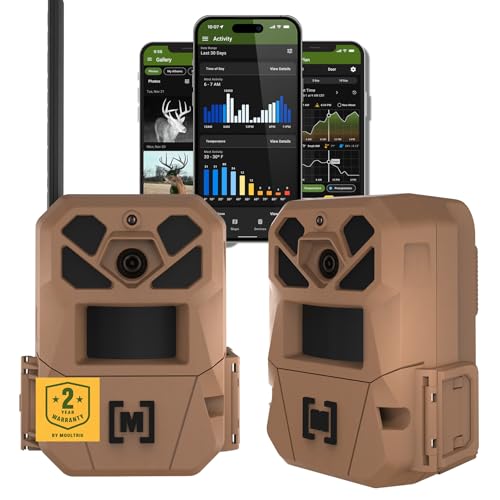
Buying one trail camera only tells you what passes through one spot, and serious deer managers know that movement patterns shift constantly. The Moultrie Edge 3 two-pack solves that by giving you two cameras at the same setup cost, perfect for covering both a food plot and a nearby bedding transition at the same time.
Compared to the single Edge 3 below, the 2-pack version simply doubles your coverage without doubling the activation headache. Both units connect through the same Moultrie app and run on the auto-connect multi-carrier LTE setup, so managing them feels like running one larger system.
The Case For It
- Two-camera bundle covers separate terrain features simultaneously for pattern tracking.
- Auto-connect across multiple U.S. carriers removes manual SIM swaps.
- 40MP still images give enough detail for antler scoring reference shots.
- 0.5-second trigger speed catches deer at a walk-through pace without empty-frame gaps.
Less Ideal Details
- Two units mean two cellular data subscriptions to track over the season.
- Standard AA batteries require more frequent swaps than the solar-equipped picks above.
Best Suited To
Multi-site deer managers tracking patterns across food plots, water sources, and bedding edges simultaneously.
A Better Fit Elsewhere
The MagicEagle Cellular Trail Camera 4G 13000mAh Battery Solar Panel 2K No-Glow suits a single-camera, long-deployment approach better.
The single-camera Moultrie Edge 3 hits a sweet spot for hunters who want proven cellular reliability without committing to a multi-pack bundle. Its standout feature is the four-network auto-connect capability, which scans and latches onto whichever U.S. carrier has the strongest signal at your specific location.
Traveling hunters benefit most from that. Move the camera between a west-Texas lease and a Michigan hunting camp, and the same unit adapts to both without a manual SIM swap. The 40MP sensor and 0.5s trigger are competitive without straying into overkill territory.
The Upside
- Four-network auto-connect removes manual carrier selection during setup.
- 0.5-second trigger keeps pace with deer moving at a brisk walk-through.
- 40MP stills handle pattern ID and antler reference work without compression artifacts.
- Single-camera price undercuts the 2-pack for solo-property users.
Small Caveats
- Runs on standard battery power, so field longevity depends on AA swap discipline.
- No built-in solar panel means an extra purchase for off-grid long-term use.
Who Will Love This
Traveling hunters who move cameras between leases in different states and want one unit that adapts to varied coverage zones.
Swap It Out When
The SEHMUA Trail Camera 2 Packs, AI Animal Detection 2K HD Live Game Camera fits a permanent off-grid install where solar matters more than trigger speed.
The Moultrie Edge 3 Pro is the camera you buy once you have outgrown a starter cellular setup and know exactly what your hunting property demands. The 0.3-second trigger is the fastest in this lineup, and that half-second advantage matters more than it sounds when a mature buck walks past at a steady clip.
Pair that with 50MP stills, 1440p QHD video, and on-device AI species recognition (software that sorts deer, hogs, and coyotes automatically), and you have a unit built for deer managers running serious herd data collection. The trade-off is a steeper upfront cost than the standard Edge 3.
Where It Helps
- 0.3-second trigger captures deer moving at a brisk pace without frame gaps.
- 50MP photo resolution supports herd managers building reference databases.
- 1440p QHD video with audio adds context to trail behavior and timing.
- On-device AI species recognition reduces the manual sort-through on photo review.
Practical Considerations
- Premium pricing puts it out of reach for casual weekend users.
- Higher resolution and AI processing demand more cellular data per trigger.
Feature Snapshot
Who Should Grab It
Serious deer managers and trophy hunters who want maximum trigger speed and on-device AI filtering for a multi-season data project.
Skip It When
The Moultrie Edge 3 Cellular Trail Camera 40MP 0.5s Trigger is the smarter spend for a solo property where 0.3s trigger speed is overkill.
MagicEagle packed an enormous 13,000mAh battery, a built-in solar panel, and a no-SIM cloud SIM card into one rugged Army Green shell. For hunters who want to drop a camera in a remote spot and walk away for months, that combination is genuinely compelling.
The SignalSync technology automatically latches onto the strongest carrier signal without any manual SIM installation, a small but meaningful quality-of-life upgrade over older cellular models. IP66 waterproofing (a rating meaning dust-tight and resistant to heavy rain) handles long wet seasons without needing a separate housing.
The Practical Payoff
- Massive 13,000mAh battery paired with solar charging supports long unattended deployments.
- No-SIM cloud technology connects to the strongest available carrier automatically.
- No-glow IR (infrared that emits no visible light) keeps the camera hidden from wary mature bucks.
- IP66 waterproofing handles extended rain exposure in field conditions.
Things To Consider
- The larger battery and solar panel add bulk compared to standard trail cameras.
- Cloud-SIM service relies on MagicEagle’s network partnerships, which may not match every coverage zone.
Quick Facts
Perfect Match For
Hunters running long-duration, off-grid deployments where battery swaps are impractical and remote connectivity matters more than trigger speed.
Reach For A Different Pick When
The SPYPOINT Flex-S-Dark Solar Cellular Trail Camera 40MP No-Glow Night Vision is the smarter fit for shorter, lower-upfront deployments in a small property.
The SPYPOINT Flex-M Solar Bundle is the easiest entry point on this list. The bundle includes the camera, a compact solar panel, an installation strap, and a heavy-duty mounting arm, so you get everything needed for a functional off-grid setup in a single purchase.
For someone setting up their first cellular trail camera, that all-in-one approach removes the usual guesswork about compatible accessories. The dual-SIM LTE design automatically switches between carriers for stronger signal, and the GPS tagging on photos helps you track movement patterns across multiple cameras.
What It Does Well
- Bundled solar panel, strap, and mount simplify first-time cellular camera setup.
- Dual-SIM LTE auto-switches between carriers for better signal reliability.
- GPS tagging on photos supports multi-camera pattern tracking.
- IP65 water resistance (resistant to low-pressure water jets) handles typical rain exposure.
Where It Is Less Suited
- IP65 rating is slightly below the IP66 rating on the MagicEagle model above for storm-prone regions.
- Standard photo resolution trails the 40MP-plus options from competing brands.
Key Attributes
Made For
First-time cellular trail camera users who want a complete bundle rather than piecing together a separate solar panel and mount.
Where A Sibling Pick Shines
The SPYPOINT Flex-S-Dark Solar Cellular Trail Camera 40MP No-Glow Night Vision is a stronger fit for pressure hunting where stealth IR matters more than beginner-friendly bundling.
The SPYPOINT Flex-S-Dark is the camera you reach for on heavily pressured public land where mature bucks have learned to flinch at the faintest red glow. The no-glow IR system emits no visible light at night, so deer never get spooked by a telltale flash from the camera’s face.
You can switch between no-glow and low-glow settings remotely through the SPYPOINT app, which is a genuinely useful feature for adapting the camera to varying hunting pressure. The built-in solar panel keeps the unit running through sunny stretches, and 40MP photos plus 1080p video with audio give you enough detail for scouting decisions.
Noteworthy Benefits
- No-glow IR keeps the camera invisible to deer on pressured hunting grounds.
- Remote switching between no-glow and low-glow modes adjusts to changing conditions.
- Built-in solar panel reduces battery swaps during sunny field deployments.
- 1080p video with sound adds behavior context beyond still images.
Points To Note
- No-glow IR typically produces slightly dimmer night images than low-glow alternatives.
- Solar charging drops off sharply in dense canopy cover or winter sun angles.
Feature Card
Whose Shelf It Belongs On
Public-land hunters and pressure-heavy properties where mature bucks spook easily and a red-glow flash would compromise your scouting setup.
Not Your Match When
The Cadrali Solar Trail Camera 4G LTE 4K Live Video 64MP Wildlife Game Camera is the better fit for wildlife filmmakers prioritizing daytime resolution instead.
Picking The Right Cellular Trail Camera For Your Setup
Cellular connectivity is the defining feature of these cameras, and most use a 4G LTE radio (a cellular data network separate from your home WiFi) to send photos and clips to your phone. That radio needs a cellular data plan, often monthly, so factor that ongoing cost into your budget alongside the hardware. Trigger speed, the delay between motion detection and photo capture, matters most when deer move quickly through frame. Anything under 0.5 seconds catches most walking deer; sub-0.3-second triggers catch animals at a trot.
Image resolution affects how much detail you can pull from a still, but it also drives cellular data consumption. A 64MP camera eats through a data plan far faster than a 40MP alternative, so match resolution to your actual scouting needs rather than chasing the highest number. Solar panels and large internal batteries extend field time but add bulk, which can complicate mounting on smaller trees.
Carrier support is another quiet but critical factor. Multi-network or dual-SIM cameras adapt to whichever signal reaches your property, while single-network units fail outright in coverage dead zones. Run a coverage map check for your specific hunting area before committing to a plan, and choose a camera that supports the strongest available carrier.
Finally, think the IR system through. No-glow (also called “invisible flash”) emits no visible light and is essential on pressured public land, while low-glow IR produces slightly brighter night images but gives away the camera’s position. IP65 and IP66 ratings both handle typical field exposure; either works for standard hunting leases and tree-line setups.
Key Considerations Across These Picks
Where Shoppers Go Wrong
The most common slip-up is buying the highest-resolution camera without checking the carrier coverage at the specific hunting spot. A 64MP unit on a weak signal will frustrate you more than a 40MP camera that actually delivers its photos on schedule. Run a coverage check before you buy, not after. Another frequent mistake is ignoring the data plan tier. Cameras that fire hundreds of times per week can burn through entry-level data plans quickly, leading to throttled speeds or overage fees mid-season.
Where The Extra Money Goes
Premium picks like the Moultrie Edge 3 Pro justify the higher cost with faster triggers, sharper imaging, and on-device AI that sorts species automatically. That matters most for serious deer managers building herd databases across multiple seasons. Casual users get more value from a mid-tier solar camera with multi-network LTE, since the extra speed and AI features rarely earn their cost in a single season. The upgrade makes sense once you are actively managing data, not just collecting photos.