
A dull hunting knife turns field dressing into a chore and ruins clean cuts on meat and hide. Hunters who pack a sharpener alongside the blade save themselves the frustration of working through bone and sinew with a tired edge. The right tool keeps skinning knives, fixed blades, and gut hooks slicing cleanly from the first trip of the season to the last.
The Choices Worth Comparing

Work Sharp Ken Onion Knife Sharpener Tool

Work Sharp Knife & Tool Sharpener Mk.2

Work Sharp Ken Onion Elite Mk2 Sharpener

AccuSharp Knife Sharpener (Blaze Orange)

Orange Ninja 4-Stage Knife Sharpener

Work Sharp Guided Field Sharpener Elite

Warthog V-Sharp A4 Replacement Hones 270 Grit

Orange Ninja Pocket Field Knife Sharpener
5 Precision Adjust 3-Stage Knife Sharpener
Taking A Closer Look At The Options
The Work Sharp Ken Onion Knife Sharpener Tool sits at the crossroads of hobby and craft. Built around a flexible abrasive belt system, it lets you set your own edge angle and walk through a controlled progression rather than guessing at the right pressure.
Hunters who keep a small rotation of skinning knives and a couple of kitchen blades appreciate having one station that handles both. Compared with the simpler AccuSharp later in this list, the Ken Onion design trades grab-and-go simplicity for repeatable precision.
The Helpful Details
- Adjustable angle guides let you match factory edges on most hunting and kitchen blades.
- Belt-based abrasion removes metal faster than rods, shortening touch-up sessions in camp.
- Compact footprint suits a garage workbench or a sturdy shelf in the mudroom.
- Designed in collaboration with bladesmith Ken Onion, which gives experienced users a familiar feel.
Things To Consider
- Belt replacement adds long-term upkeep versus a single stone or pull-through unit.
- Best results come with a little practice, so first-time users may need a few attempts.
Key Specs
Right Fit For
Knife enthusiasts who want dialed-in angles and don’t mind a small learning curve.
A Better Fit Elsewhere
Hunters who want a grab-and-go field tool should consider the AccuSharp Knife Sharpener (Blaze Orange) for its pull-through simplicity.
The Mk.2 sharpens every knife you own, and the included replacement belt kit extends the system’s working life right out of the box. It builds on the original Work Sharp design with quicker belt changes and more consistent results.
Switching from a 25-degree outdoor edge to a 20-degree kitchen edge happens in one guide, which matters when you’re moving between a skinner and a chef’s knife in the same session. The included spare belts also mean less downtime once the original set wears down.
What Pays Off
- Quick angle swaps cover hunting and kitchen blades without retooling.
- Scratch-resistant leather lining on the guides protects blade finishes.
- Replacement belts ship with the unit, so you can refresh without a separate order.
Worth Noting
- Requires bench space and a power source, so it’s a stationary tool.
- Belt life depends on how often you sharpen and the hardness of your steel.
Made For
Households that maintain a mix of hunting, kitchen, and pocket knives in one place.
Look Elsewhere When
Backcountry hunters should reach for the Work Sharp Guided Field Sharpener Elite, which packs a guided system into a portable case.
Ken Onion’s Elite Mk.2 pairs the guided sharpening cassette of the standard Ken Onion tool with a dedicated blade grinding attachment. The result is a complete benchtop system that handles both touch-ups and more involved reshaping work.
For someone who repairs chipped tips or reprofiles older hunting blades, the grinding module is the real draw. It opens up jobs that the standard Work Sharp belt sharpener would struggle to address cleanly.
Points In Its Favor
- Two-in-one design covers routine sharpening and heavier grinding in one footprint.
- Guided cassette promotes repeatable results across multiple knives.
- Suited to a workshop setting where it lives permanently on the bench.
Trade Offs
- Larger and pricier than the standard Ken Onion Knife Sharpener Tool.
- Overkill for owners who only need occasional touch-ups.
Quick Facts
Best Suited To
Workshop hunters and pros who want one benchtop station for full blade care.
Consider Something Else When
Casual sharpeners will find the Work Sharp Ken Onion Knife Sharpener Tool more than enough for routine work.
The AccuSharp Knife Sharpener is a small V-shaped pull-through with a handle that fits the palm. A few strokes is all it usually takes to bring a tired edge back, which is why it ends up in truck boxes and camp kits.
The Blaze Orange handle makes it easy to spot in grass or on a dark workbench. Compared with the belt-driven Work Sharp tools, this is a much more minimal approach, but for quick field touch-ups it’s hard to argue with the simplicity.
A Few Strong Suits
- Compact body slips into a pack pocket or glove box.
- Ergonomic handle keeps strokes controlled without much practice.
- Restores both straight and serrated edges with the same tool.
Honest Caveats
- Less precise than angle-guided systems, so it’s not ideal for fine kitchen blades.
- Replacements and consumables depend on use; owners commonly report the sharpening surface eventually wearing and needing a swap.
Whose Shelf It Belongs On
Hunters who want a no-fuss sharpener that lives in the truck or the pack rather than on a bench.
Reach For A Different Pick When
Anyone maintaining premium kitchen knives will do better with the 5 Precision Adjust 3-Stage Knife Sharpener and its angle selection.
The Orange Ninja 4-Stage Sharpener runs a blade through four slots: a carbide stage for repair, a diamond stage for sharpening, a fine stage for polishing, and a dedicated slot for serrated edges. That progression covers most kitchen and hunting knives a typical household owns.
It’s a pull-through design, so there’s almost no learning curve. Compared with the simpler AccuSharp, you get more refinement options at the cost of a slightly larger footprint on the counter.
Why It Works Well
- Four-stage progression handles repair, sharpening, polishing, and serrated edges.
- Pull-through layout keeps the technique consistent for new users.
- Non-slip base tends to keep it stable during sharpening strokes.
Room For Improvement
- Larger than pocket-sized tools, so it’s a counter or drawer item.
- Pull-through slots give less angle control than adjustable systems.
Perfect Match For
Home cooks and casual hunters who want one tool that handles the full knife drawer.
Swap It Out When
Travel-focused shoppers will appreciate the Work Sharp Guided Field Sharpener Elite for its portable case.
The Work Sharp Guided Field Sharpener Elite packages a five-stage sharpening system into a tool small enough to fit in a pack. The included travel case, made of durable polyester with a sturdy nylon zipper, keeps everything together when the terrain gets rough.
Angle-guided stages help you hold a consistent edge in the field, which is the real trick to keeping a hunting knife cutting cleanly far from a workbench. Compared with the bulkier Work Sharp Ken Onion Knife Sharpener Tool, this one prioritizes portability over depth of material removal.
Useful Touches
- Five-stage system covers repair, sharpening, and finishing in one compact unit.
- Angle guides reduce guesswork when you’re working outdoors.
- Polyester travel case keeps the stages clean and organized.
Points To Note
- Smaller abrasive surfaces mean slower material removal than a full benchtop sharpener.
- Best suited to field touch-ups rather than major reprofiling.
Who Should Grab It
Backcountry hunters and anglers who want one rugged kit to keep blades serviceable away from home.
Another Choice May Suit
Hunters running a Warthog V-Sharp system at camp should look at the Warthog V-Sharp A4 Replacement Hones 270 Grit instead.
These Warthog replacement hones refresh the cutting surfaces on the V-Sharp A4 and Classic II systems. At 270 extra-coarse grit, they’re built for reshaping edges and stripping damage before moving to finer hones.
These hones only fit Warthog’s own clamp-style sharpeners, so they’re not a standalone tool. For owners already running a V-Sharp, they extend the system’s working life and broaden the grit range available.
Noteworthy Benefits
- 270-grit diamond surface handles heavier repair work quickly.
- 4.75-inch hones fit both the A4 and Classic II Warthog sharpeners.
- Hang-packaged format keeps the hones protected until they’re installed.
Points To Keep In Mind
- Only useful if you already own a compatible Warthog sharpener.
- Extra-coarse grit is too aggressive for routine touch-ups.
Feature Snapshot
Built With In Mind
Existing Warthog owners who need an aggressive grit for reshaping worn hunting blades.
Skip It When
Hunters without a V-Sharp system should start with the Work Sharp Guided Field Sharpener Elite for a complete portable kit.
The Pocket Field Knife Sharpener packs six sharpening options into a body that fits in a pocket or pack lid. A 220-grit diamond plate repairs dull blades quickly, while a 600-grit plate finishes the edge.
A carbide slot handles fast touch-ups, and a guided system supports more controlled work. It covers straight edges, serrated blades, and gut hooks, which is what most hunters actually carry into the field.
Positive Points
- Six functions cover the knife and tool types hunters typically carry.
- Pocket-sized body removes the excuse of leaving the sharpener behind.
- Guided sharpening mode helps when conditions make freehand work tricky.
Less Ideal Details
- Smaller abrasive area means slower work than a benchtop belt sharpener.
- Some users may find the multi-stage layout takes a moment to learn.
The Right Fit
Hunters on foot who want one pocket tool that handles repair, sharpening, and gut-hook work.
Where A Sibling Pick Shines
Hunters who already use a Warthog V-Sharp at base camp can refresh it with the Warthog V-Sharp A4 Replacement Hones 270 Grit.
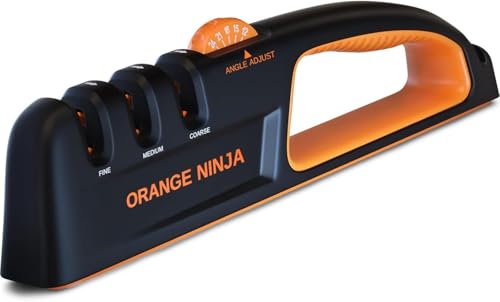
The 5 Precision Adjust Knife Sharpener gives you angle choices at 12, 15, 18, 21, and 24 degrees through a three-stage progression. That range covers everything from a delicate paring knife to a thicker outdoor edge.
The handheld design and ergonomic grip keep the technique straightforward. The catch is that it’s built for straight-edge blades, so serrated hunting knives and scissors fall outside its scope.
What Works In Its Favor
- Five angle settings match a wide range of blade types and steel hardnesses.
- Three-stage progression walks the edge from repair to polish.
- Ergonomic handle keeps strokes steady during longer sessions.
Factors To Consider
- Not suitable for serrated blades or scissors.
- Better suited to indoor kitchen use than rough field conditions.
Spec Overview
Who Will Love This
Angle-conscious sharpeners who want to dial in a precise edge on straight-blade hunting and kitchen knives.
Not Your Match When
Hunters carrying serrated folders or gut hooks will do better with the Orange Ninja Pocket Field Knife Sharpener.
Factors To Consider When Choosing Hunting Knife Sharpeners
Edge Type And Steel Hardness
Hunting knives come in a mix of carbon steel, stainless steel, and tool steel, and each responds differently to abrasive surfaces. Harder steels hold an edge longer but take more time to sharpen, so a tool with multiple grit stages usually pays off over the long run. Softer steels sharpen quickly but lose the edge faster, which means a portable touch-up tool can matter as much as the benchtop system.
Portability Versus Stationary Use
A field hunter needs a sharpener that lives in a pack or a pocket, while a home cook or workshop user needs something that sits on a counter or bench. Compact pull-through tools and pocket kits handle quick touch-ups in camp. Belt-driven and angle-guided systems deliver more precise results but require a stable surface and, in some cases, power.
Angle Control And Repeatability
Edges angled between 15 and 25 degrees cover most hunting and kitchen knives. A sharpener that locks in a chosen angle removes the guesswork and helps you recreate the same edge each time. Pull-through and freehand systems work fine for general use, but angle-guided sharpeners make sense once you care about matching factory bevels.
Compatibility With Serrated And Specialty Blades
Many hunting knives include serrated sections, gut hooks, or scissors. A sharpener with a dedicated serrated slot or a flexible abrasive that conforms to scalloped edges handles these tools without damaging them. Straight-edge-only systems are fine for kitchen blades but will leave serrated knives untouched.
Key Considerations Across These Picks
Common Shopping Slip Ups
The most common mistake is buying a pull-through sharpener and expecting angle-perfect results on premium blades. Pull-through tools are fast and approachable, but they don’t lock in a specific angle. Another trap is overlooking whether the sharpener handles serrated blades or just straight edges, which leaves part of your kit unsupported. Owners commonly report frustration when belts or abrasive surfaces wear out faster than expected, so factoring replacement costs upfront prevents surprises.
What The Higher Tier Buys
Premium benchtop systems like the Work Sharp Ken Onion Elite Mk2 add grinding attachments, more precise angle guides, and longer-lasting abrasive components. The extra spend typically goes into sturdier frames, finer angle control, and modular setups that handle bigger repair jobs. For someone who sharpens frequently or maintains expensive steel, the upgrade tends to pay off in better edges and fewer replacements. Casual sharpeners often find mid-tier options like the Work Sharp Knife & Tool Sharpener Mk.2 more than enough for routine care.
Frequently Asked Questions
How often should a hunter sharpen a field knife?
Most hunters touch up an edge every few trips or whenever the blade starts to drag instead of slice. Heavy use on bone and hide dulls steel faster than light camp tasks.
Can one sharpener handle both kitchen and hunting knives?
Yes, especially angle-guided systems and multi-stage pull-through tools. The key is matching the angle to the blade category before each session.
Are diamond sharpeners safe for hunting steel?
Diamond abrasives work well on most modern hunting steels, including stainless and tool steels. Using lighter pressure and shorter strokes helps control material removal.
What’s the difference between a guided sharpener and a freehand stone?
A guided sharpener locks the blade at a fixed angle, which makes results repeatable for less experienced users. Freehand stones give more control but require practice to maintain a consistent angle.
Do serrated blades need a special sharpener?
Serrated blades benefit from a tapered rod or a dedicated serrated slot that fits the scallops. Standard pull-through slots tend to skip over the curved sections rather than sharpening them.