Long-range scouting gets harder the further your target sits from the road. A solid spotting scope turns a distant shape into antlers, branches, or a rifle target you can actually read. The eight spotters below cover a real spread of sizes, price tiers, and feature sets, so you can match one to your hunting style without overspending on glass you will never use.
A Snapshot Of The Selections
PickWhy We Picked ItBest ForAction

Top PickVortex Diamondback HD 16-48×65 Spotting Scope
Balanced everyday choice
All-around hunters on a budget
Premium PickVortex Razor HD 22-48×65 Spotting Scope
Compact high-end glass
Backcountry packers and weight-watchers
Heavy Duty PickVortex Razor HD 27-60×85 Spotting Scope
Large objective light grabber
Long-range shooters at dawn and dusk
Well Rounded PickVortex Viper HD 15-45×65 Spotting Scope
Refined mid-range performer
Glassers who want HD without flagship cost
Value PickVortex Crossfire HD 20-60×80 Spotting Scope
Big 80mm objective on a budget
Spot-and-stalk hunters needing aperture
Feature RichGUANIEE 25-75×80 Spotting Scope Kit
All-in-one accessory package
Newcomers wanting tripod and phone adapter
Budget FriendlyGUANIEE 25-75×60 Spotting Scope Kit
Lightweight, ready-to-use kit
Casual shooters and beginners
Tech Forward PickGUANIEE Digital Spotting Scope with 4K Screen
Built-in screen and recording
Digi-scopers and content sharers
The Strengths Of Each Pick
The Vortex Diamondback HD 16-48×65 angled spotter is the kind of optic most hunters will reach for first. Its 16-48x magnification range covers everything from a wide ridge scan at dawn to reading a target’s shoulder at distance, and the 65mm objective (the front lens that gathers light) keeps weight manageable on a long hike. Owners commonly praise the helical focus wheel for letting them dial in fast without overshooting crisp focus.
Compared to the pricier Razor HD picks below, the Diamondback gives up some low-light punch but keeps the angled-body ergonomics hunters prefer for sitting and tripod work. For most public-land hunters scouting elk or mule deer before the season, this is the sweet spot of price and performance.
Key Advantages
- ✓16-48x zoom range fits most big-game hunting distances
- ✓65mm objective balances aperture with packable weight
- ✓Helical focus wheel speeds up fine adjustments in the field
- ✓Angled body sits lower, making tripod use more comfortable
- ✓Vortex’s reputation for solid entry-tier HD optics
Things To Consider
- •Smaller 65mm front lens gives up some light versus 80mm and 85mm options
- •At the top of the 48x range, image sharpness drops compared to the Razor HD line
- •Tripod sold separately, which adds to the total cost
Who It Suits Best
Rifle hunters who need one reliable spotter for spot-and-stalk and long sits without paying flagship prices.
Consider Something Else When
Serious low-light glassers chasing sheep at last light will get more reach from the Vortex Razor HD 27-60×85 angled spotter in the next pick.
The Vortex Razor HD 22-48×65 in straight-body form is built for hunters who care about edge sharpness. The HD optical system pushes noticeably cleaner color and contrast than the Diamondback above, and the straight-through design lets you sit on a shooting mat without craning your neck. For backcountry packing, the 65mm objective keeps the rig light enough to actually bring.
You give up the wider zoom range of the Diamondback, trading 16x for a tighter 22x floor, but you gain a noticeably flatter field (uniform focus from center to edge). Pronghorn and sheep hunters, who tend to glass for long sessions across open country, often gravitate here.
Useful Strengths
- ✓HD glass holds edge-to-edge sharpness at high magnification
- ✓Straight body suits prone and low-angle glassing positions
- ✓Compact 65mm tube is friendlier for packing than the larger 85mm sibling
Worth Noting
- •Smaller objective means less light in deep timber or heavy overcast
- •Premium optics push the cost well above the Diamondback
Made For
Hunters who chase open-country game and want flagship-tier glass without hauling a heavier 85mm body.
Look Elsewhere When
Hunters glassing in deep shade or running tight dawn-to-dark sessions should size up to the Vortex Razor HD 27-60×85 angled spotter for its larger light-gathering objective.
The Vortex Razor HD 27-60×85 angled is the long-reach option in this roundup. The 85mm objective pulls in noticeably more light than the 65mm Razors above, which is the difference between picking up a bedded buck in shadow and squinting at a brown blob. Hand-selected HD glass elements target distortion-free views at the edge of the field, a real help when scrutinizing a target at 60x.
That extra aperture comes with real weight and a tripod-hungry footprint. If your hunt mostly happens within 400 yards, this scope is overkill, but for long-range shooters punching steel or hunting open sage country, the extra reach earns its keep.
Everyday Wins
- ✓85mm objective pulls noticeably more light at dawn and dusk
- ✓27-60x range handles long-range rifle work and far-off bedded game
- ✓HD lens system targets a flat field across the image
Points To Keep In Mind
- •Bulky body demands a sturdier tripod than smaller spotters
- •Heavier carry for backcountry hunters on foot
Best Suited To
Long-range shooters and open-country hunters running dawn-to-dark glass sessions where light matters more than pack weight.
A Better Fit Elsewhere
Hunters who mostly stalk timber and need a lighter pack should step down to the Vortex Viper HD 15-45×65, which keeps HD quality but cuts the size.
The Vortex Viper HD 15-45×65 angled sits in the comfortable middle of Vortex’s lineup. The 15x low end is friendlier for wide ridge-line scans than the Razor HD 22-48×65 above, and the HD optical system still gives you a clear upgrade over the Diamondback for color and contrast. A multi-position eyecup (the rubber cup against your eye that sets viewing distance) helps dial in comfort with or without glasses.
You give up some of the flagship-grade flat field of the Razor HD line, but for the hunter who wants HD without flagship cost, the math works. The Viper HD often gets recommended as the most “set-and-forget” spotter in Vortex’s catalog.
What Makes Sense
- ✓Wide 15-45x range fits both scanning and identifying
- ✓XR anti-reflective coatings (lens coatings that reduce glare) help in flat light
- ✓Locking collar allows the scope to rotate into different viewing positions
- ✓Angled body suits tripod work across long sits
Honest Caveats
- •Edge sharpness drops more noticeably than on the Razor HD at full zoom
- •Still on the heavier side compared to sub-65mm travel options
The Right Fit
Versatile hunters who want one spotter for everything from ridge scanning to close-quarter deer ID without overspending on flagship glass.
Reach For A Different Pick When
Backpack hunters chasing weight savings under every gram should consider the more compact Vortex Razor HD 22-48×65 instead.
The Vortex Crossfire HD 20-60×80 angled is the budget door into 80mm-class glass. That extra objective size over the Diamondback above gathers noticeably more light for first-light hunts, which can be the difference between a confirmed target and a guess. The 20-60x range covers the practical window for most big-game work and rimfire or centerfire target shooting.
It costs less than the Viper HD and Razor HD siblings, so you’ll see more optical softness at the edges and a slightly less refined focus knob. For hunters who want a big objective without crossing into flagship pricing, this is the entry ticket.
Useful Highlights
- ✓80mm objective adds meaningful low-light performance at this price
- ✓20-60x zoom suits both spot-and-stalk and long-range target use
- ✓Arca-Swiss compatible foot (a standard tripod plate pattern) works with most modern tripods out of the box
Points To Note
- •Bigger body needs a stable tripod to avoid shake at 60x
- •Edge sharpness and color fidelity trail the Viper HD line
Who Should Grab It
Budget hunters who want real aperture for dawn glassing without paying flagship-tier prices.
Skip It When
Glassers chasing the cleanest edge-to-edge image should save up for the Vortex Viper HD 15-45×65, which targets better color and contrast for a modest step up.
The GUANIEE 25-75×80 arrives as a complete spotting kit: scope, full-size tripod, phone adapter, and a carry bag. For a first-time scope owner who does not want to research a separate tripod or dig into phone-digiscoping mounts, this package gets you glassing the same afternoon it shows up. The 80mm objective and 75x top-end magnification handle both range days and casual wildlife viewing.
Compared to the Vortex Crossfire HD 20-60×80 above, the optics are a clear step down in color fidelity and edge sharpness, but the included accessories save real money for shoppers starting from zero.
The Upside
- ✓Tripod, phone adapter, and bag included at one price
- ✓80mm objective pulls useful light at dawn and dusk
- ✓75x top magnification covers most hunting and rimfire range distances
Trade Offs
- •Optics trail dedicated hunting brands on color and edge sharpness
- •Included tripod is functional but not heavy-duty for windy days
Perfect Match For
First-time scope owners who want a turnkey package without buying accessories one at a time.
Another Choice May Suit
More experienced hunters chasing better optical quality at the same aperture should pick the Vortex Crossfire HD 20-60×80 and budget for a quality tripod separately.
The GUANIEE 25-75×60 is the lighter sibling to the 80mm kit above. The 60mm objective keeps the package under five pounds with the tripod, which matters if you’re hiking a half-mile to a vantage point before sunrise. The fully multi-coated 60mm lens (a lens with multiple anti-reflective coatings on every air-to-glass surface) and BAK4 prism (a high-density glass prism that brightens the image) help keep the image presentable in decent light.
This is a casual tool, not a serious glassing instrument, but for backyard rimfire, casual birding, or introducing a kid to the sport, the included tripod, phone adapter, and carry bag cover the basics. In heavy cover or at high magnification, expect softness to creep in.
Where It Helps
- ✓Lightweight carry under five pounds with tripod attached
- ✓Tripod, phone adapter, and carry bag included
- ✓60mm lens keeps bulk and cost reasonable
Less Ideal Details
- •Smaller objective limits use in low-light conditions
- •Image softness increases noticeably past 50x magnification
Built With In Mind
Casual shooters and newcomers who want a kit they can grab and go without committing to flagship prices.
Where A Sibling Pick Shines
Hunters who want real low-light reach should step up to the GUANIEE 25-75×80 kit, which adds 20mm of objective for noticeably brighter dawn images.
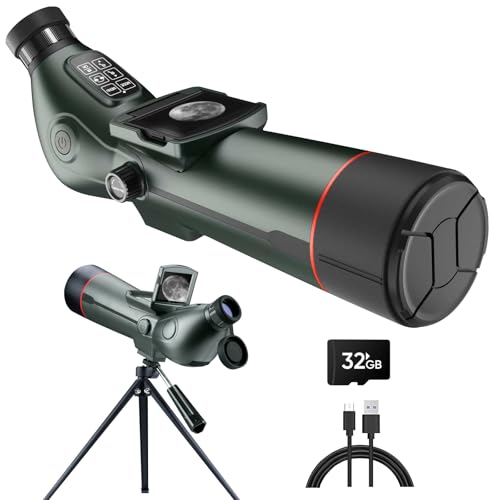
The GUANIEE Digital Spotting Scope flips the script on traditional glass. A 2.8-inch flip-up display on the scope body shows what the lens sees, captures 4K images and video, and ships with a 32GB SD card already in the box. Up to 350x claimed magnification and auto-focus let you frame a distant subject without juggling a phone adapter.
This is the pick for content creators, casual stargazers, and hunters who want a record of what they saw rather than a pure optical experience. Traditional optics like the Vortex Diamondback HD above will still pull in more natural light per dollar, but the digital workflow is unmatched at this price for sharing what you spot.
Strong Points
- ✓Built-in screen and 4K capture eliminates extra phone adapters
- ✓32GB SD card and tripod included in the kit
- ✓Auto-focus helps beginners frame distant subjects quickly
Practical Considerations
- •Sensor-based image trail traditional glass in pure low-light performance
- •Battery-powered operation means charging before each trip
Whose Shelf It Belongs On
Digi-scopers and casual content creators who want a record of what they glass rather than a traditional optic-only experience.
Swap It Out When
Pure glassing purists chasing edge-to-edge clarity will be happier with the Vortex Viper HD 15-45×65, which delivers natural HD views without a sensor in the path.
What Matters Most Before Choosing Hunting Spotting Scopes
Aperture And Objective Size
The objective lens, the large front glass element on a spotting scope, dictates how much light reaches your eye and how bright the final image looks. For dawn hunts in heavy cover, a 65mm objective works, while an 80mm or 85mm front glass pulls in noticeably more usable detail. The trade-off is weight and tripod size.
Magnification Range And Field Of View
A wide zoom floor like 15x or 16x helps you scan a whole ridge at once, while topping out at 60x lets you read a target’s antler structure. Field of view (how much scenery you see at a given magnification) shrinks as zoom climbs, so balance the two for your hunting style. Long-range target shooters want higher top-end; spot-and-stalk hunters benefit more from a low wide-end.
Body Style And Tripod Compatibility
Angled bodies sit lower to the ground for seated glassing and tripod use, while straight-through designs help prone glassing without neck strain. Whichever you pick, an Arca-Swiss compatible foot (a standard tripod mounting plate pattern) snaps onto most modern tripods without extra plates, saving time on setup.
Optical Coatings And Glass Quality
HD or extra-low dispersion glass (special glass that reduces color fringing) cuts chromatic aberration, the colored fringe you see around high-contrast edges at high magnification. Multi-coated lenses improve light transmission and reduce glare in flat light, which matters most for dawn glassing when animals move.
Key Considerations Across These Picks
Common Shopping Slip Ups
The most common miss is buying magnification range you will not actually use. A scope that tops out at 75x sounds impressive, but if you hunt inside 500 yards, the wider field of view at 20x gets used every trip. The other trap is forgetting the tripod. A heavy scope on a flimsy head turns into a shaky view at 60x, so budget for the tripod alongside the optic.
What The Higher Tier Buys
Stepping from a Crossfire or Diamondback into the Razor HD line pays for hand-selected HD glass elements and tighter optical tolerances. In real terms, that means cleaner color at the edges of the field and noticeably flatter focus across the whole image. For glassers who spend hours behind the scope every season, the upgrade pays off in eye fatigue as much as image quality.
Frequently Asked Questions
QWhat magnification do I need for hunting spotting scopes?
Most big-game hunters do well with a 15-45x or 20-60x range. Long-range target shooters who read bullet impacts often want 27-60x or higher top-end. A wider low end helps you scan ridges faster before zooming in.
QAre angled or straight spotting scope bodies better for hunting?
Angled bodies are more common for tripod hunting because they sit lower and let you glass downhill or uphill without craning your neck. Straight bodies suit prone glassing or bench-rest target use where you already sit at scope height.
QDo I need a separate tripod for a hunting spotting scope?
Yes, almost every spotter on the market requires a tripod because handholding high magnification is impractical. A stable head rated for the scope’s weight matters more than saving money on a flimsy stand, especially at 60x or above.
QWhat objective size is best for low-light hunting?
An 80mm or 85mm objective pulls in noticeably more light than a 60mm or 65mm, which helps at dawn and dusk. The trade-off is bulk and weight, so backcountry hunters often settle for 65mm and accept the low-light compromise.
QHow important are HD or extra-low dispersion glass elements?
They reduce colored fringing around high-contrast edges at high magnification, which matters when reading antler shape or bullet holes. For casual hunters, standard optics are fine; for serious glassers, HD glass reduces eye fatigue on long sessions.